
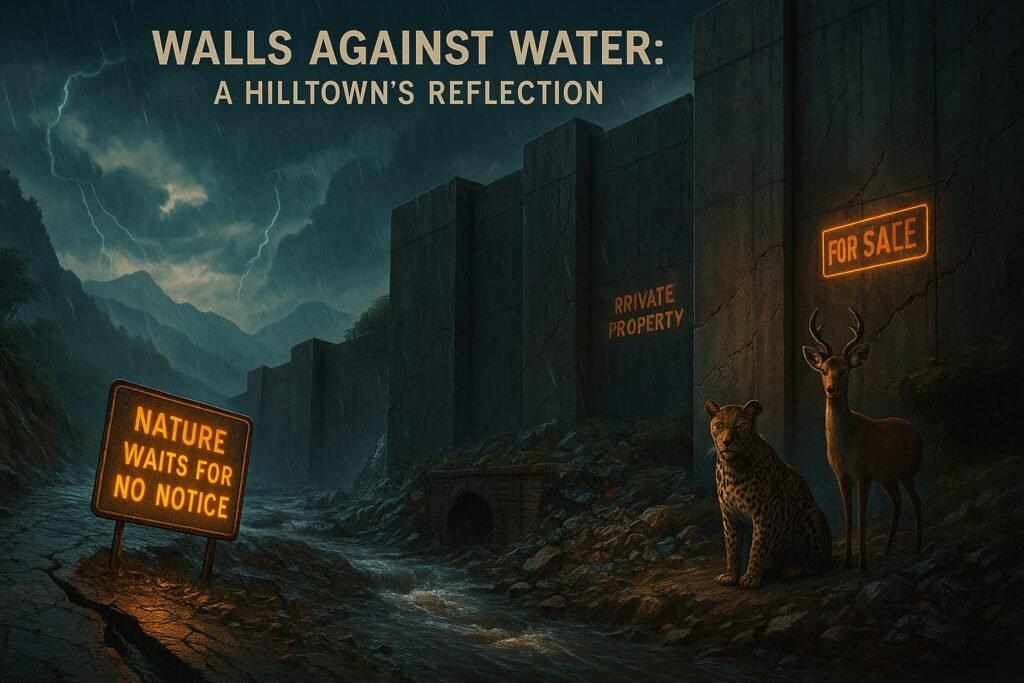
I live in Mussoorie. And every time I walk along Camel’s Back Road or the slopes near George Everest, I feel the same unease: where there were once open slopes, there are now walls; where rain drains once flowed, there are blockages of stone, plastic, and cement. At Company Garden Road, nallahs gasp under heaps of garbage, while bulldozers stand as belated guardians of a crisis already unleashed.
This is not a complaint against a neighbor, nor an accusation against one builder. It is a reflection of how we, as a hill town community, have slowly forgotten the wisdom of the mountain.
The Forgotten Veins of the Mountain
Every hill has veins. They are not made of concrete pipes but of natural rain drains, gullies, and slopes that carry the monsoon’s excess down to the rivers. Our ancestors understood this. They built light, they respected the slope, and above all, they left space for water to breathe.
Today, those veins are being suffocated. Drains are blocked, covered, built over. Garbage fills the culverts; walls seal the water’s path. What we forget is that water does not forgive blockages. It remembers. And when denied its natural course, it carves new ones—through our roads, through our retaining walls, through our foundations.
Every landslide, every sinking road in Mussoorie is not just a “natural disaster.” It is nature correcting the errors of our forgetfulness.
Law, Reports, and Silence
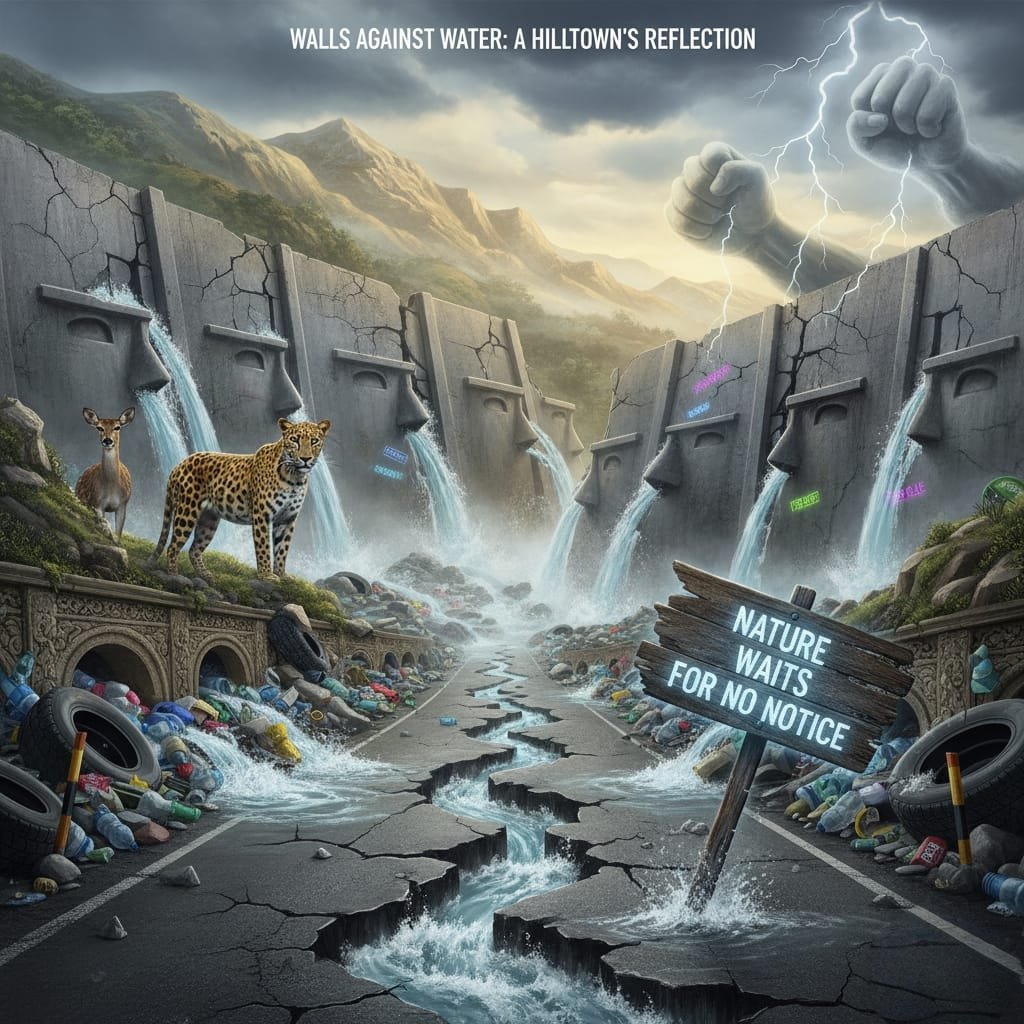
The law is clear. The Uttar Pradesh Municipalities Act of 1916, still binding in Uttarakhand, gives local bodies the authority to remove any unauthorised wall or structure built over a drain. KEEN’s report, handed in to the Nagar Palika three years ago, identified 16–17 rain drains blocked across Mussoorie. The causes and consequences were already mapped.
And yet, the drains remain blocked. The walls remain standing. Reports gathered dust, notices became paperwork, and silence filled the space where action should have been. The truth is simple: nature does not wait for our notices.

Not Just Mussoorie — A Pattern Across Uttarakhand
Walk beyond Mussoorie and you see the same story unfolding across the state. In Joshimath, the ground sank as drains and natural slopes were buried under years of construction. In Chamoli, rivers narrowed by encroachments rose back in fury. In Pauri and Almora, rain drains were sealed by colonies, leading to the collapse of entire retaining walls.
It is tempting to call these accidents. But when the same story repeats from one district to another, it is no longer chance—it is a pattern of forgetting. A collective arrogance that the mountain will bend to our walls and our cement.
North India’s Wider Mirror
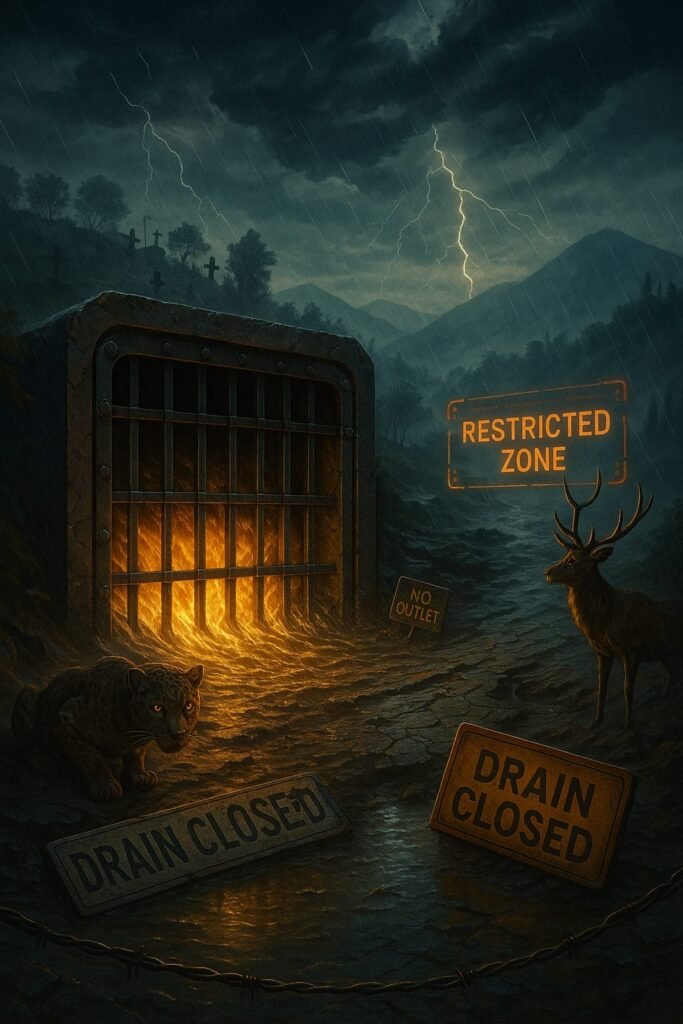
And it is not just Uttarakhand. Across North India, the same forgetting plays out. In Himachal, retaining walls collapse each monsoon. In Punjab and Haryana, canal flows are blocked by illegal colonies, leading to waterlogging and flash floods. Delhi itself is a reminder: a city built over floodplains, constantly battling the river’s memory.
The mountain and the plains are telling us the same truth in different tongues: you cannot block the path of water and expect peace.
The Shared Blame, The Shared Burden
When citizens say, “We too are to blame,” they are right. It is not just about authorities or builders. Every plastic wrapper tossed into a drain, every hillside paved without thought, every silence when a nalla is blocked—it is all our fingerprint.
But this shared blame is also a shared chance for redemption. If the problem was man-made, the cure too can be man-made. Clearing nallahs is not a municipal formality. It is survival. Letting water breathe is not charity to nature. It is self-preservation.
A Philosophy for the Hills
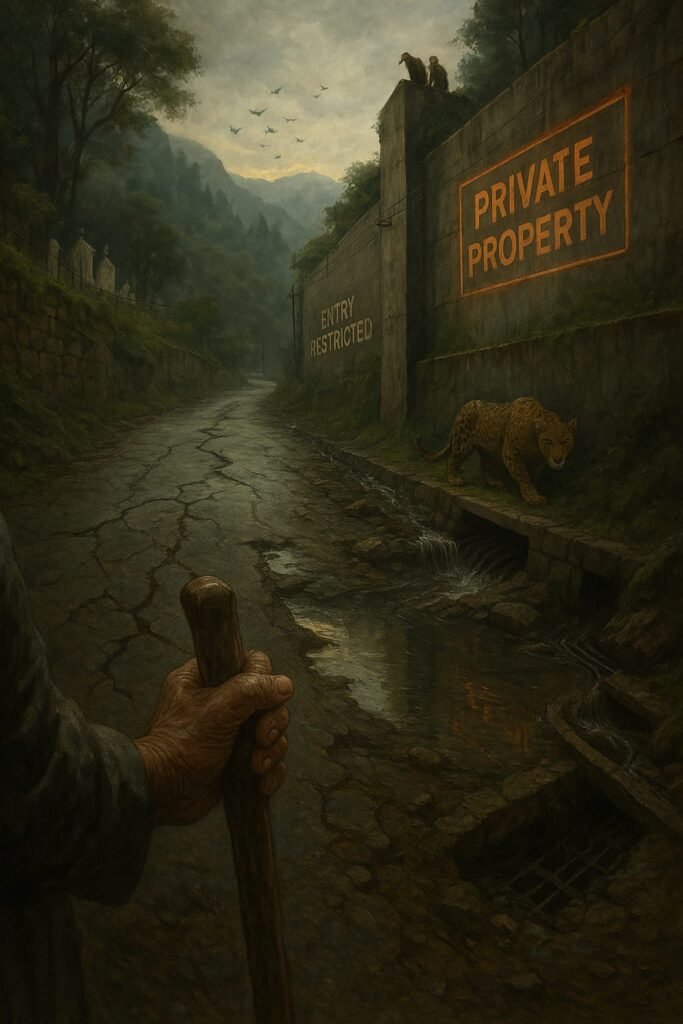
The mountain does not punish. It simply remembers. It remembers the flow of its drains, the breath of its forests, the balance of its slopes. When we block those memories with walls, garbage, or negligence, it simply reclaims them—through landslides, road collapses, or floods.
The old hill wisdom was simple: never block a drain, never build heavy on a slope, never forget that the mountain is older than you. Somewhere along the way, in our rush to “develop,” we buried that wisdom under brick and plastic.
But the mountain still whispers. And if we listen, we may yet find a balance where towns can thrive without choking their own lifelines.
Closing Reflection
Mussoorie is my mirror. I see its drains blocked, its roads sinking, its walls rising—and I see not just my town, but the entire northern belt of India in the same state. From the Himalayas to the floodplains, the question is the same: will we continue to build walls against water, or will we remember to let it flow?
Because in the end, walls may protect a plot, but they will sink a town. Drains may look dirty, but they are the veins of the mountain. And as the pines remind us each monsoon: “Block the water, and you block yourself. Free the water, and you free your future.”


Rajat Aikant Sharma is a writer and photojournalist exploring culture, history, and human stories. Beyond print, he creates digital content, posters, and social campaigns that extend his editorial voice into the world of influencer engagement and brand storytelling
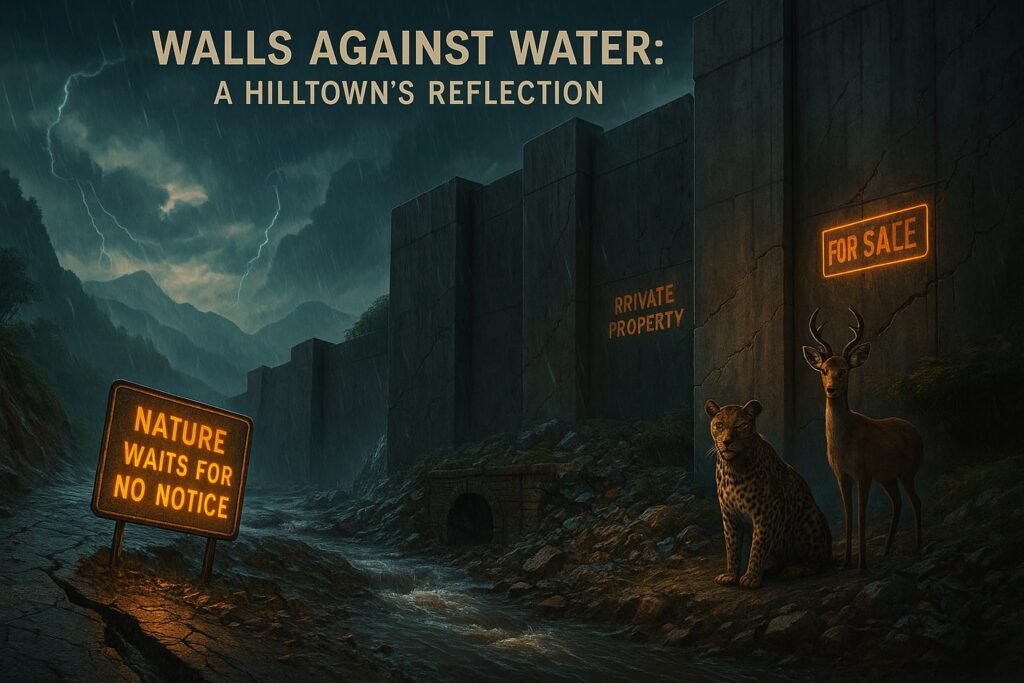
Walls Against Water: