COSMIC REFLECTIONS:
In the vast expanse of the universe, science and spirituality often seem worlds apart. Yet, occasionally, a poetic hypothesis emerges—a bridge of thought connecting particle physics with ancient metaphysics.
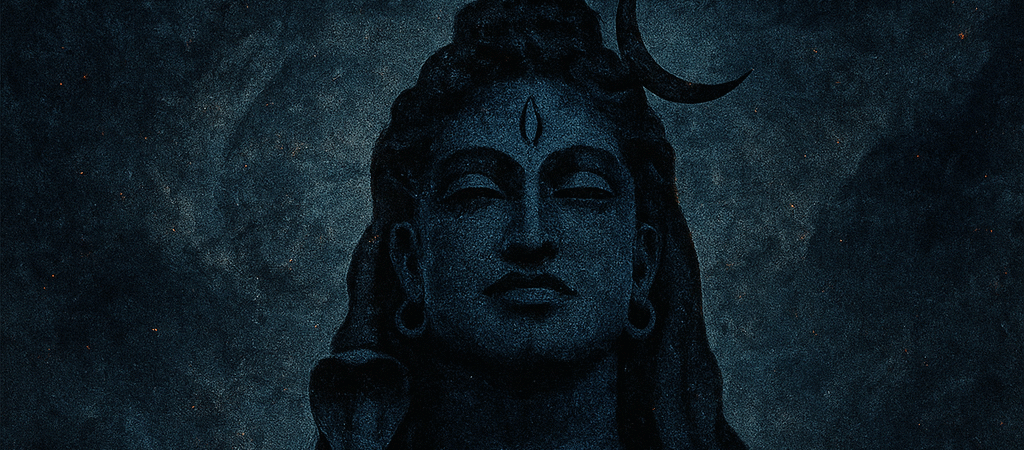
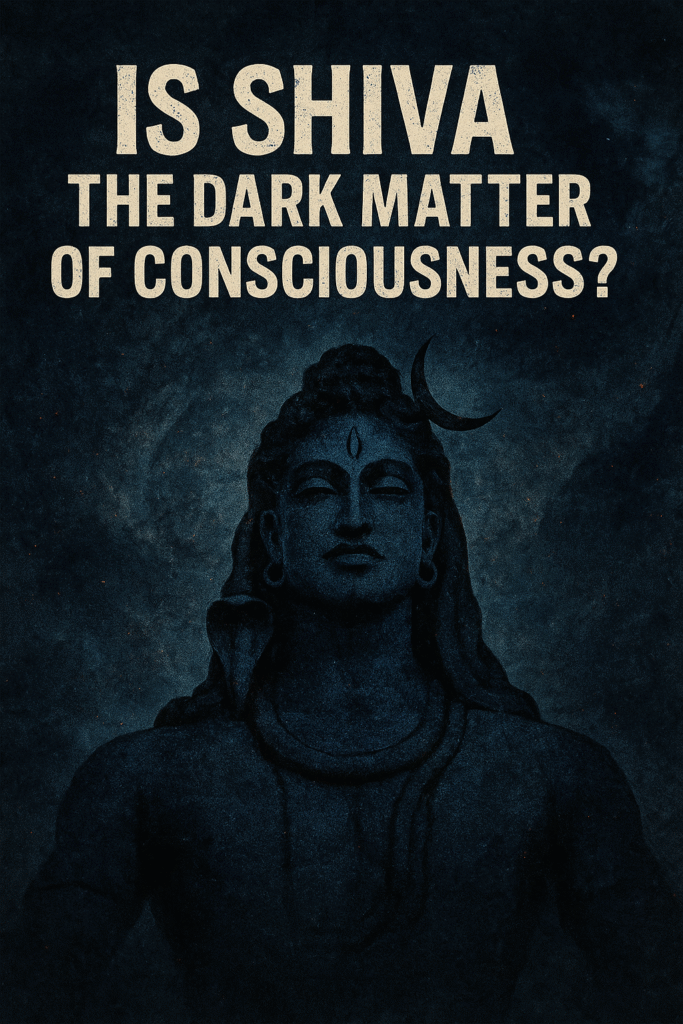
Could Shiva, the cosmic deity of transformation and stillness, symbolize—or subtly connect to—the enigma of dark matter?
The Invisible Majority
Modern astrophysics reveals that dark matter constitutes approximately 85% of the universe’s matter. Invisible, intangible, and undetectable by electromagnetic waves, it neither emits nor reflects light. Yet, its existence is undeniable, inferred through its gravitational influence on galaxies and the cosmic web.
Dark matter is the unseen scaffolding of the cosmos, shaping the universe without revealing itself.
Shiva: The Stillness Behind Motion
In Hindu philosophy, particularly Shaivism and Kashmir Shaivism, Shiva transcends the concept of a deity. He is chit—pure consciousness—the formless (nirguna) essence underlying all existence. Yet, he is also saguna, manifesting in myriad forms: the fierce Rudra, the meditative Dakshinamurti, the cosmic dancer Nataraja, or the silent ascetic yogi.
Shiva embodies both the void and infinite possibility—a cosmic principle weaving between nothingness and everything.
The Panpsychist Bridge
Panpsychism, a philosophical perspective gaining traction in speculative science, posits that consciousness, or proto-consciousness, is a fundamental property of all matter. If even matter possesses a trace of awareness, could dark matter hold a form of consciousness utterly distinct from our own?
Might this “conscious presence” in dark matter resonate with Shiva-tattva—the unseen, unknowable essence of Shiva that permeates all forms yet remains beyond grasp?
Shapeless Yet Form-Giving
Like Shiva, dark matter is formless yet shapes the cosmos. It sculpts galaxies, guides the motion of stars, and upholds the universe’s architecture. Its influence is universal, yet it has no fixed form.
In mythology, Shiva manifests as the universe demands—a beggar, a teacher, a lover, or a destroyer. His form shifts with perception, much like dark matter’s effects vary depending on the observer’s lens.
Science Meets the Sacred
This is not a scientific claim. No evidence suggests dark matter is sentient or conscious. Yet, as science probes the limits of observation and consciousness remains an unsolved mystery, metaphor becomes a bridge.
Shiva as a symbol for dark matter—and dark matter as a cosmic reflection of Shiva’s formless, omnipresent essence—invites not answers, but contemplation.
Could the ancient sages, through the language of myth and meditation, have glimpsed an unseen field of potential that modern physics is only now beginning to explore?
The Final Thought
In a universe where form arises from the formless, where the seen dances to the rhythm of the unseen—
Could Shiva be the dark matter of consciousness?
And if so, what are we—light, shadow, or something in between?