A Question Echoing Through Time
What if Abraham, the patriarch of three of the world’s largest religions, was not merely a man born of the desert winds, but a distant echo of an ancient Brahmin sage—a spiritual archetype resonating across ages? What if the story of monotheism did not begin with a covenant under the stars of Canaan, but with the Upanishadic whisper of “Ekam Sat Vipra Bahudha Vadanti“—“Truth is One, but the wise call it by many names”?
Could Abraham be a memory—a linguistic echo, or even a symbolic transformation of Brahma, the creator in Hindu cosmology? Are the spiritual lineages of the world truly separate, or are they branches of a single tree—rooted in a primordial, cyclically recurring order known in Hinduism as Sanatana Dharma?
This article is not a historical assertion but a philosophical journey through time, language, and myth. It is an invitation to listen for echoes in the caves of forgotten civilizations, where the hymns of a shared past may still resonate.
Time as the Eternal Spiral
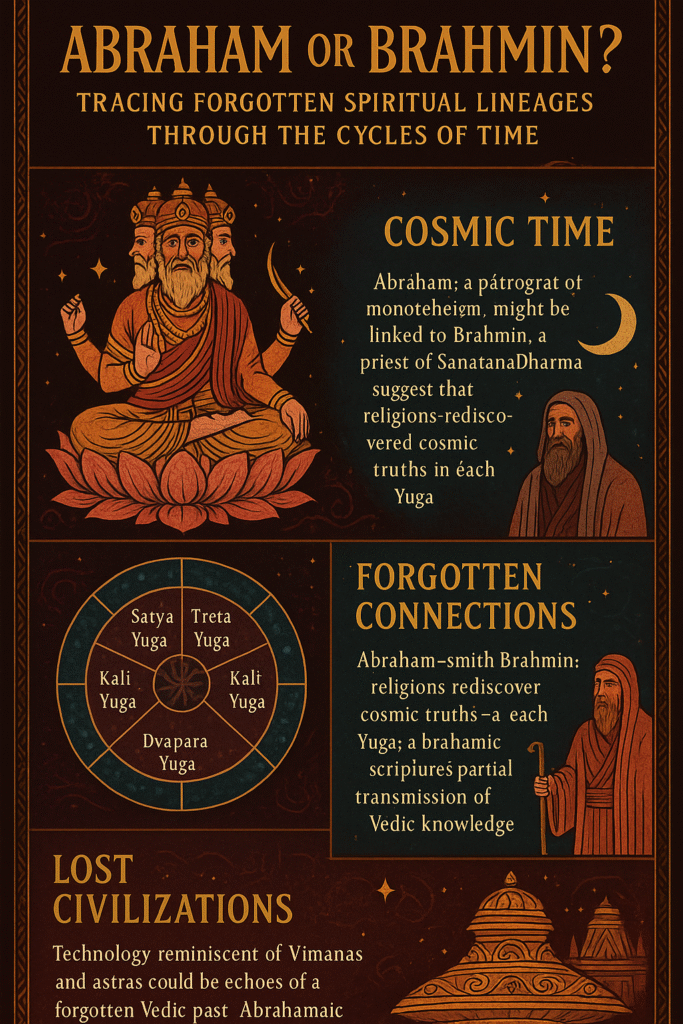
Unlike the linear time of modern historiography, Hindu cosmology perceives time as a vast spiral. Here, epochs are measured not in centuries but in Yugas (ages), Manvantaras, and Kalpas:
- A single Mahayuga spans 4.32 million years.
- 71 Mahayugas form a Manvantara.
- 14 Manvantaras compose a Kalpa—one day in the life of Brahma.
- Brahma’s lifespan? 311 trillion human years (according to Puranic cosmology).
In this framework, civilizations do not merely rise and fall; they recur, dissolve, and re-emerge like waves in an eternal ocean. The Vedas themselves are considered apauruṣeya (not of human authorship)—revealed anew in each cycle to rishis attuned to cosmic truth.
So if an Abraham existed in a prior age, was he a wanderer in Mesopotamia—or a rishi of Bharatvarsha? Or was he both—the same essence returning in another form, under another sky?
The Linguistic Temptation: Abraham and Brahma
The phonetic resemblance between Abraham and Brahma (or Brahmin) is striking:
Ab-Raham: Hebrew for “father of many nations.”
Brahma: The creator deity, born from Vishnu’s navel, who sets existence into motion.
Brahmin: The knower of Brahman (ultimate reality); custodian of sacred wisdom.
Similarly, Abraham’s wife Sarah mirrors Saraswati—goddess of wisdom and consort of Brahma. While most linguists attribute these parallels to coincidence—Abraham deriving from the Proto-Semitic Av-hamon and Brahma from the Sanskrit root Bṛh, meaning “to expand”—the symbolic kinship lingers in esoteric traditions.
Could Abraham have been a Brahmin sage whose teachings migrated westward? Or does the overlap hint at a deeper, archetypal truth—that spiritual founders are vessels of a perennial wisdom?
Echoes of Ancient Knowledge
Hindu scriptures describe realities that transcend primitive tribalism:
- Vimanas: Celestial chariots (Ramayana, Mahabharata).
- Brahmastra: Weapons akin to nuclear arms.
- Lokas: Multidimensional realms (from Bhuloka to Brahmaloka).
To the rishis, these were not metaphors but experiential truths, accessed through tapas (austerity) and yogic siddhis (attained powers). Some even believe Sanskrit and Tamil to be divine languages, descending from higher realms. While mainstream historians interpret these accounts as myth or allegory, the cosmic vision remains compelling.
In this worldview, Earth is but one stage. Civilizations rise across dimensions, and teachings are seeded, forgotten, and reborn. Could Abraham—or the current he carried—have been such a seed? A shoot from the tree of Sanatana Dharma, taking root in the sands of Ur ?
Mystical Syncretism: The One Beneath the Many
Despite surface differences, world religions share profound convergences:
- A singular Divine (Brahman, Allah, YHWH).
- Ethical law rooted in transcendence (Dharma, Torah, Sharia).
- Guides (avatars, prophets, rishis) who restore balance.
Advaita Vedanta, the non-dualistic school of Hindu philosophy, teaches that all names and forms are manifestations of one consciousness. Thus, gods, prophets, and angels may be facets of the same reality, refracted through different cultural prisms.
Perhaps Abraham was not a founder but a rememberer—one who reawakened an ancient covenant between humanity and the Divine, long before scriptures were etched.
History as Forgetting
Modern history relies on artifacts and inscriptions, but spiritual truth is preserved differently: in myth, ritual, and the soul’s recognition of what it already knows.
Hindu tradition places us in Kali Yuga, an age of spiritual amnesia. Here, even the gods are veiled, and humanity clings to fragments.
Abraham may be such a fragment—a name, a vibration, a Brahmin who crossed deserts instead of rivers, built altars instead of yajnas, or perhaps a universal archetype—yet still gazed upon the Infinite.
The Inward Turn
The question is not whether Abraham was literally a Brahmin, but what his legacy points toward. Whether we name the Divine Brahman, Elohim, or Allah, the journey toward it must ultimately pass through the Self.
As the Chandogya Upanishad proclaims:
- “Tat tvam asi—Thou art That.”
Perhaps, under Canaan’s stars, Abraham remembered a flame not of this world—one first kindled in Agni’s fire, still alight in every seeker’s heart.
Conclusion: The One Tree, Many Leaves
To claim that all religions stem from Hinduism is simplistic. But to recognize them as branches of an eternal, cyclical wisdom—rediscovered by avatars, prophets, and sages across the ages—is to touch a profound truth.
Abraham may be a Brahmin in memory. A Brahmin may become an Abraham in a future cycle. The river of time flows strangely—but its Source remains.
May your journey lead not only through texts, but inward—toward the flame that remembers.