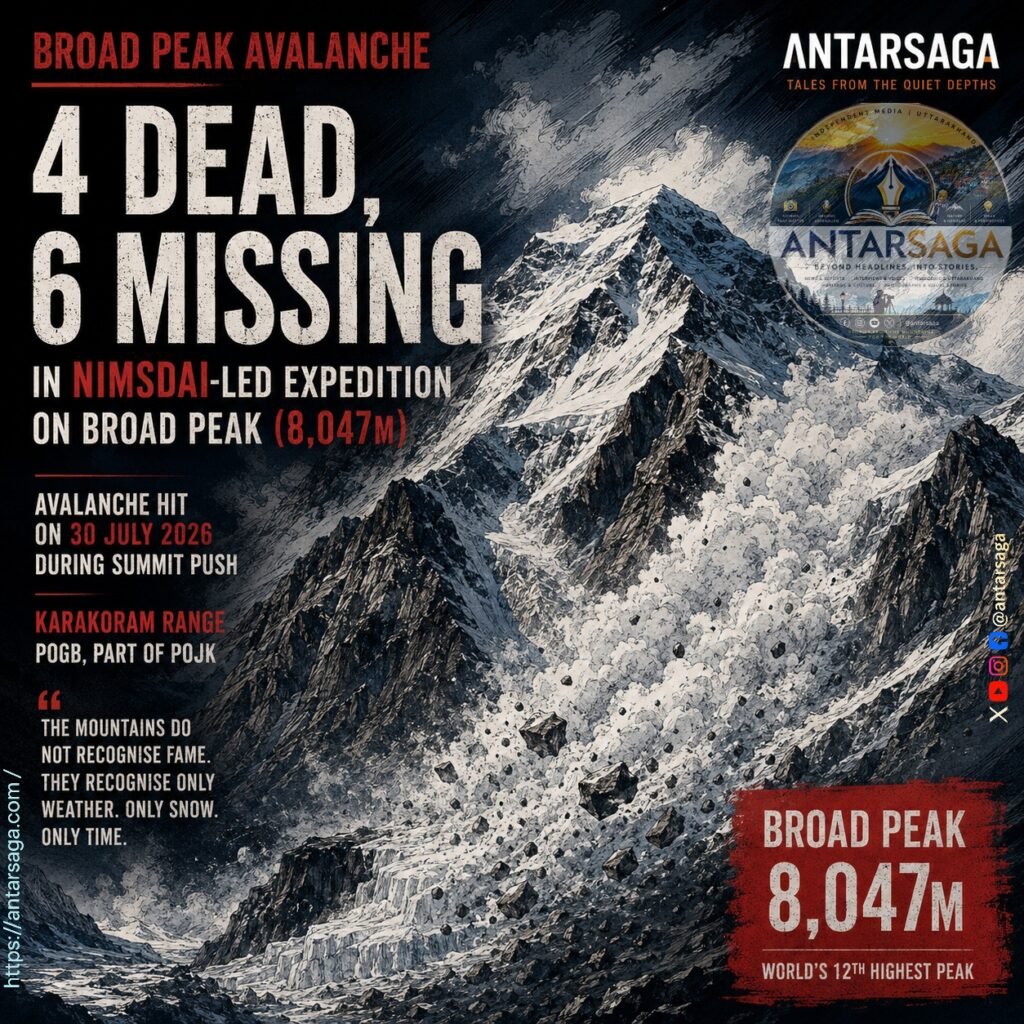
Four Climbers Confirmed Dead, Six Feared Missing as Nirmal “Nimsdai” Purja-Led Expedition Meets Disaster on Broad Peak
AntarSaga News | Global Affairs | 31 July 2026
Some news stories are reported. Others are mourned.
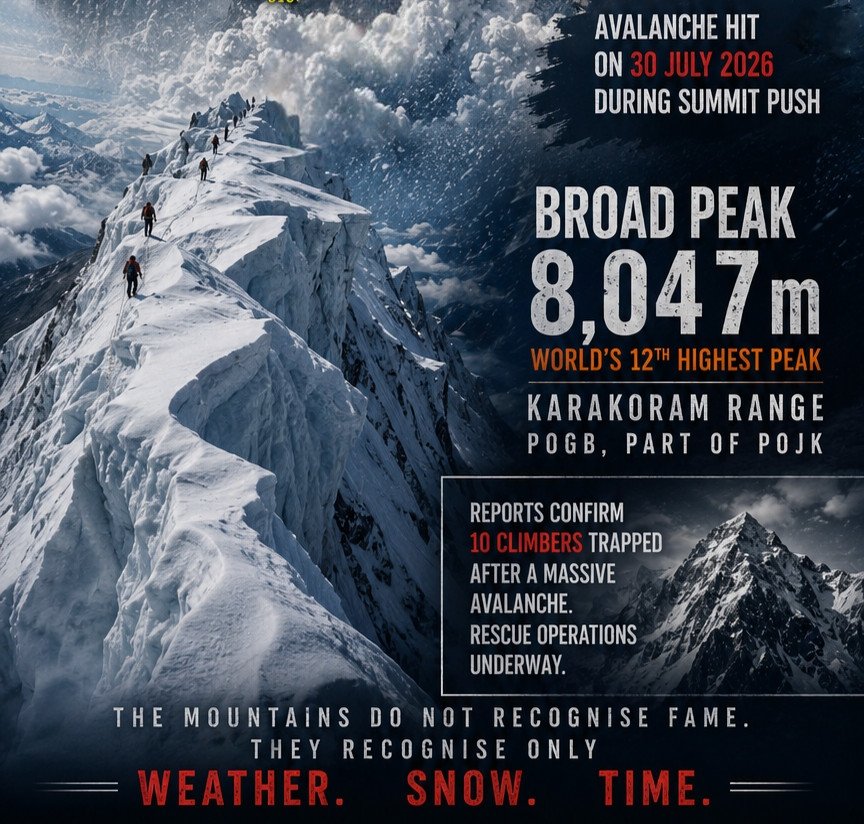
The global mountaineering community is reeling after a devastating avalanche struck an international expedition on 30 July 2026 on Broad Peak (8,047 metres) in the Karakoram Range, located in Pakistan-occupied Gilgit-Baltistan (PoGB), part of Pakistan-occupied Jammu & Kashmir (POJK), near the China border. The avalanche hit shortly after midday during the team’s summit push, with GPS data indicating several climbers may have been swept nearly a kilometre down the mountain before all communication with base camp was lost.

According to the latest official updates from the Alpine Club of Pakistan and authorities in Gilgit-Baltistan, four climbers have been confirmed dead, while six others remain missing. Two of the deceased have been officially identified as Nadhira Ahmed Abdullah Al Harthy of Oman and Pur Bahadur Gurung (“Yukta”) of Nepal. The identities of the remaining two recovered climbers have not yet been officially released. Rescue operations, involving Pakistan Army Aviation helicopters and specialised ground teams, have repeatedly been suspended because of severe weather, poor visibility and continuing avalanche danger.
Standing beside the mighty K2 (8,611 metres), Broad Peak is the world’s 12th-highest mountain and one of the legendary 14 eight-thousanders. Known for its vast summit ridge, unstable snowfields and relentless avalanche risk, it remains one of the most demanding objectives in high-altitude mountaineering.
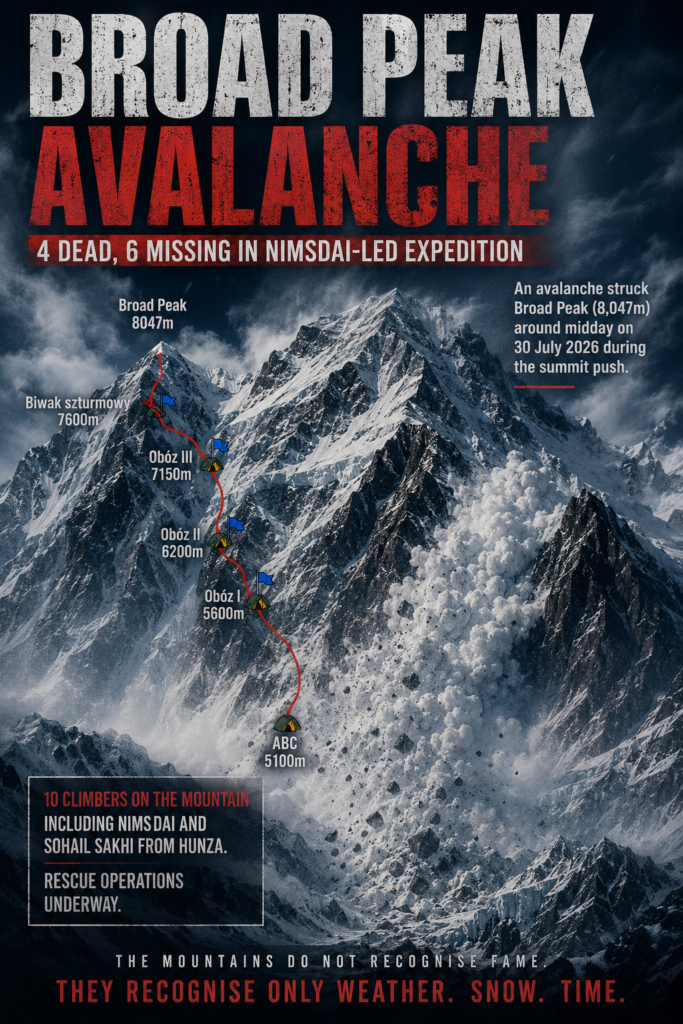
At the heart of the expedition was Nirmal “Nimsdai” Purja, the Nepal-born British mountaineer who transformed modern climbing by summiting all 14 mountains above 8,000 metres in just 189 days in 2019—an achievement that shattered the previous record and inspired climbers across the world. A former British Gurkha and the first Gurkha accepted into Britain’s elite Special Boat Service (SBS), Purja later led the historic first winter ascent of K2 with an all-Nepali team and became globally recognised through the Netflix documentary 14 Peaks: Nothing Is Impossible.
Just days before beginning the expedition, Purja wrote on X:
“Broad Peak, I ask for nothing but safe passage up and back down. My purpose has never been about me. It’s about what I represent. It’s about showing you that your own mountains—whatever they are—are climbable.”
Today, those words echo with heartbreaking poignancy.
The Expedition Team
The multinational expedition comprised:
- Nirmal “Nimsdai” Purja – Nepal/Britain (Expedition Leader)
- Pur Bahadur Gurung “Yukta” – Nepal (officially confirmed deceased)
- Kili Pemba Sherpa – Nepal
- Nima Sherpa – Nepal
- Gyalu Sherpa – Nepal
- Nawang Thindu Sherpa – Nepal
- Sohail Sakhi – Pakistan (Hunza)
- Mallory Geis – United States
- Wang Zhong – China
- Nadhira Ahmed Abdullah Al Harthy – Oman (officially confirmed deceased)
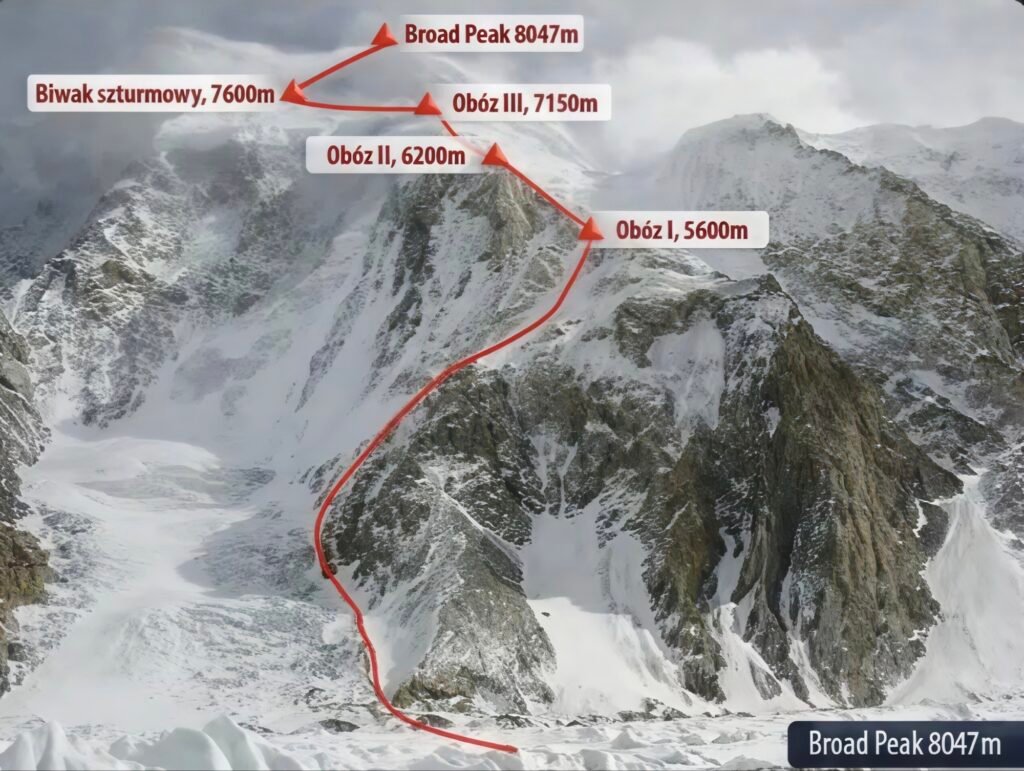
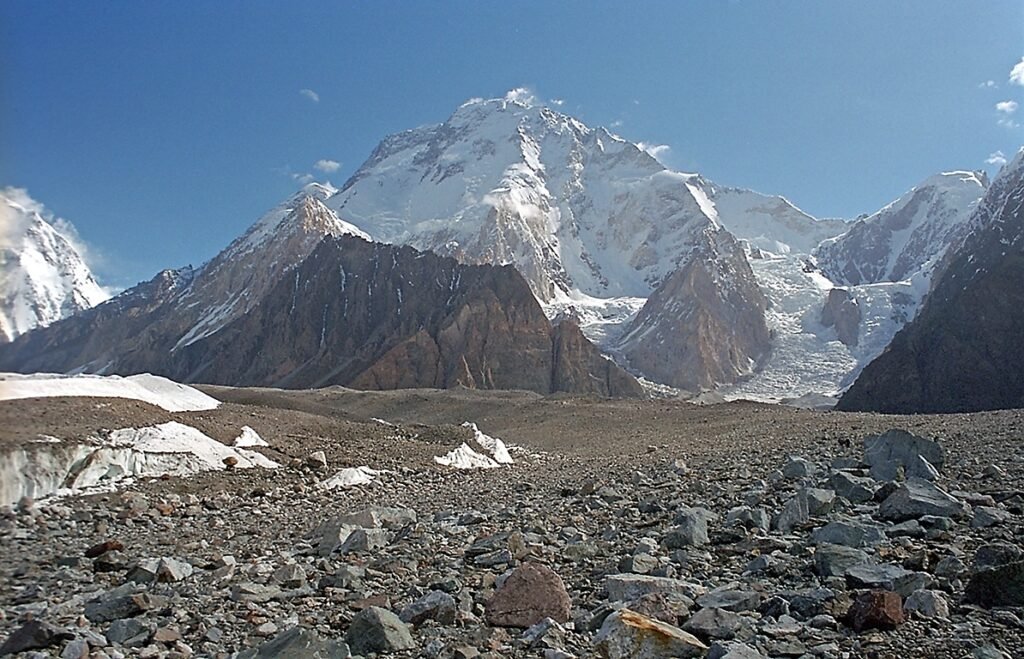
Among the team were some of the world’s finest mountaineers. Mallory Geis, a climber from Texas, had closed her Pilates studio to pursue what she called “a giant leap of faith” and was attempting her first 8,000-metre expedition in Pakistan. Sohail Sakhi, a respected Pakistani guide from Hunza, geographer and high-altitude photographer, was reportedly undertaking what was expected to be his final 8,000-metre expedition in Pakistan. Veteran climber Kili Pemba Sherpa, who has summited Everest 15 times, famously guided double-amputee Xia Boyu to the top of Everest in 2018 and was also part of the historic winter ascent of K2.
Specialist mountaineering publication ExplorersWeb reported that drone reconnaissance has spotted additional victims on the mountain and that GPS trackers indicate several missing climbers may have come to rest around 5,800 metres. Those findings, however, await official confirmation.
Perhaps the most moving chapter of this unfolding tragedy has emerged not from Broad Peak itself, but from neighbouring K2. Several international expeditions reportedly abandoned their long-awaited summit attempts to join the rescue mission. In the world’s highest mountains, competition gives way to compassion. The summit can wait—but a fellow climber cannot.
A Mountain Older Than Its Name
Long before it appeared on modern maps, the surrounding Karakoram formed part of the vast Himalayan world through which traders, Buddhist monks, pilgrims and explorers travelled between the Indian subcontinent, Tibet and Central Asia. Ancient Buddhist manuscripts discovered in nearby Gilgit bear witness to a civilisational landscape that predates modern borders by many centuries.
The mountain itself remained largely unknown to the outside world until the 19th century. During the Great Trigonometrical Survey and the strategic rivalry known as the Great Game, British surveyors systematically mapped the Karakoram.
Broad Peak was originally designated K3, as it was the third major peak surveyed in the Karakoram after K1 and K2. In 1892, British explorer Sir Martin Conway gave it the name “Broad Peak“, inspired by its unusually wide summit ridge stretching nearly 1.5 kilometres across the skyline.
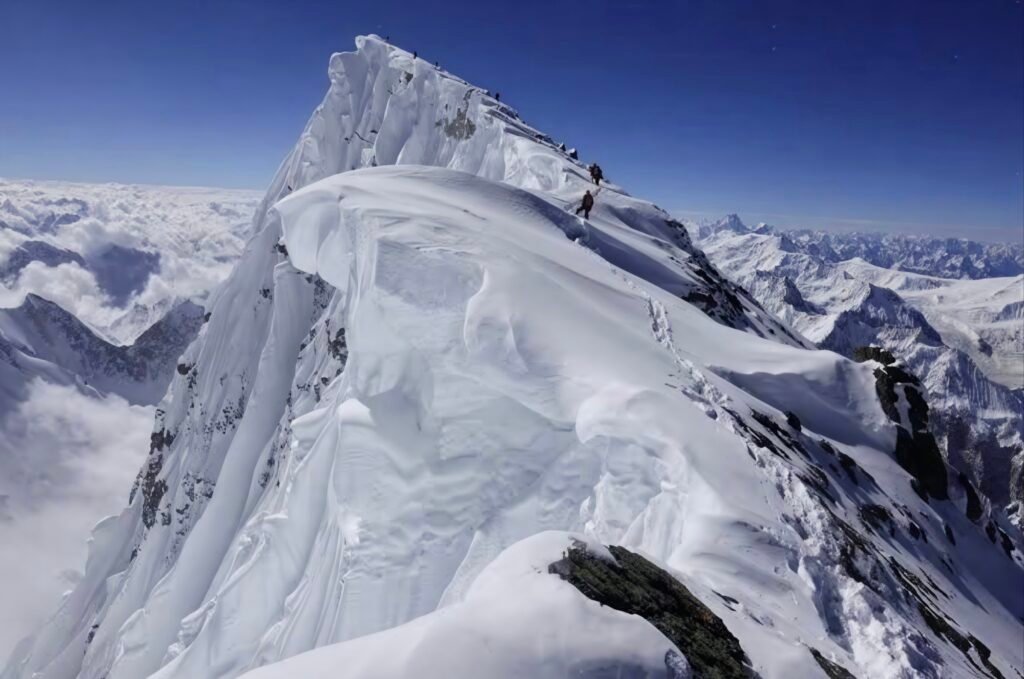
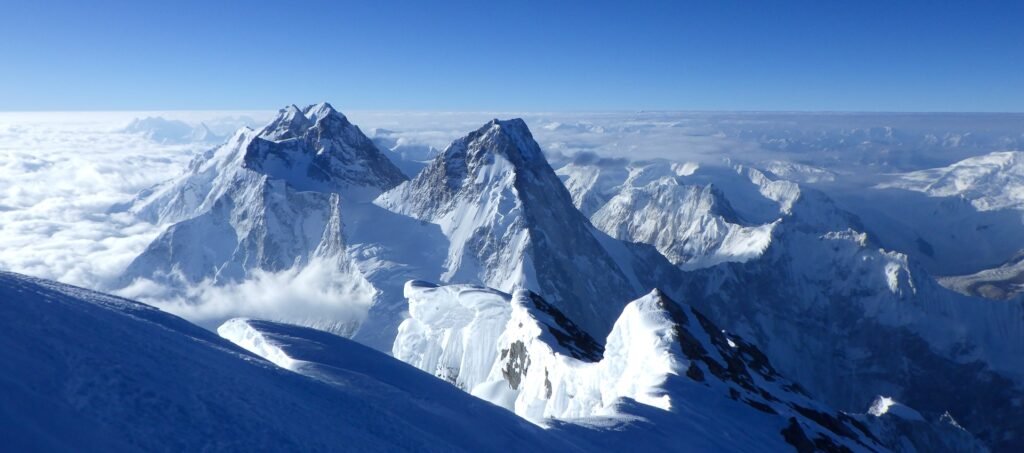
The mountain was first successfully climbed on 9 June 1957 by an Austrian team comprising Fritz Wintersteller, Marcus Schmuck, Hermann Buhl and Kurt Diemberger, becoming one of the earliest 8,000-metre peaks to be conquered. Since then, Broad Peak has witnessed extraordinary triumphs—and heartbreaking losses. One of its deadliest climbing seasons came in 2013, when at least six climbers lost their lives.
Yet despite decades of exploration, Broad Peak has never surrendered its authority. Its steep faces, hidden crevasses, thin air and avalanche-prone slopes continue to remind every climber that experience may reduce risk—but never eliminate it.
The tragedy has united mountaineers from Nepal, India, Pakistan and across the world in hope, grief and prayer. Families wait for answers. Rescue teams prepare to resume their search as soon as weather permits. Across the global climbing fraternity, thousands are watching, hoping against hope.
The mountains do not recognise fame.
They do not recognise nationality.
They do not recognise records.
They recognise only weather.
Only snow.
Only time.
Today, Broad Peak is remembered for an avalanche. But long before surveyors named it, before climbers sought its summit, and before borders divided these highlands, these mountains stood as silent witnesses to the journeys of monks, merchants, explorers and civilizations.
The mountains have changed little.
It is humanity that keeps returning—seeking purpose where the air grows thin, and meaning where the world falls away.
Until every climber is accounted for, the silence over Broad Peak belongs not only to the Karakoram—but to the entire mountaineering world.
— AntarSaga | Tales from the Quiet Depths