In the Beginning, There Were Serpents…
Before man walked the Earth and gods took to the skies, there were serpents—celestial, coiled, and ancient beyond time. In the deepest folds of Hindu cosmology, the Nāgas emerge not as mere reptiles of fear but as luminous beings, both feared and revered, who dwell in realms that exist beneath and beyond our world.
These aren’t just mythological footnotes. The Nāgas are the sentinels of hidden dimensions, the custodians of karma, and guardians of cosmic energy. Sometimes divine, often terrifying, they appear in scriptures, epics, and dreams—with glistening scales, jeweled hoods, and eyes that mirror the abyss.
Shapeshifters of the Divine: The Dual Nature of Nāgas
Born of sage Kashyapa and Kadru, the Nāgas embody a sacred paradox. They are both protectors and destroyers, healers and avengers. They dwell in Nāgaloka, a subterranean or perhaps interdimensional world of golden palaces, glowing rivers, and halls echoing with the chants of the ancient.
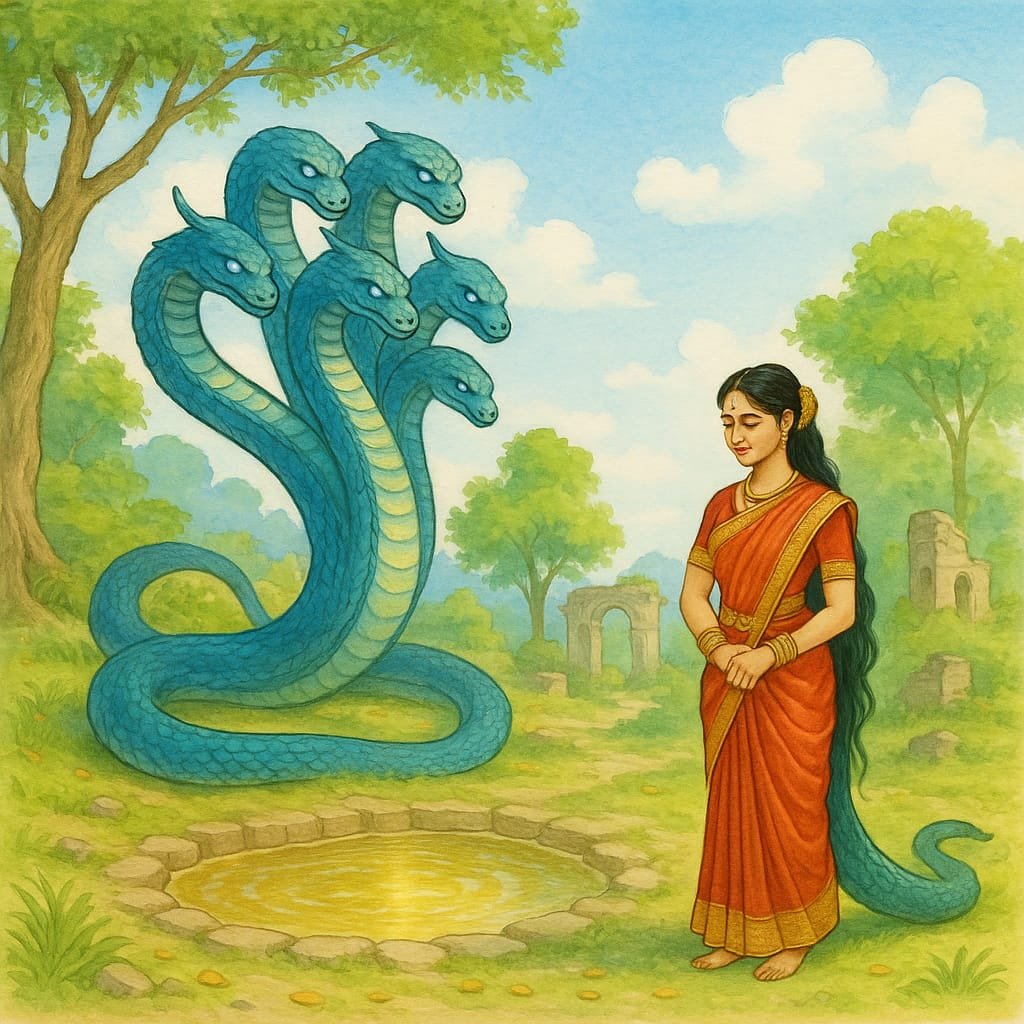
But these serpents are not bound by form. Nāgas are shape-shifters—appearing as humans, divine women (Nāg Kanyas), or dreams that slither into one’s subconscious only to leave symbols behind. Their duality reflects Rta—the cosmic order of opposites, the law that binds life and death in a divine rhythm.
And sometimes… they walk among us.
Encounters with the Otherworldly: Love, Poison, and Portals
From the epic depths of the Mahabharata comes the tale of Ulupi, a Nāg Kanya who pulls Arjuna into her underwater palace. There, she seduces him not with charm alone, but with the profound power of otherworldly grace. Their son, Iravan, is a child of two realms—half-human, half-serpent—a symbol of unity between seen and unseen.
Then there is Takshaka, the Nāga king who, in a blaze of divine wrath, kills King Parikshit and sparks the terrifying Sarpa Satra—a mass snake sacrifice so powerful it threatened the destruction of the entire serpent race.
And let’s not forget the vision of Krishna dancing on Kaliya’s hoods, restoring balance to the poisoned Yamuna—an image so potent, it still echoes through temple songs and folk tales today.
These aren’t just stories. They are encounters—clues scattered across time, urging us to ask: were the Nāgas simply legends, or emissaries from a world just out of reach?
Nāgaloka: A Kingdom Beneath or a Realm Beyond?
Hindu cosmology speaks of Nāgaloka—not as a hellish pit, but as a resplendent underworld, shimmering with gems and serpentine wisdom. It is said to lie beneath Bhūloka (our Earth), yet accessible only through divine will or karmic passage.
But what if it’s not underground at all?
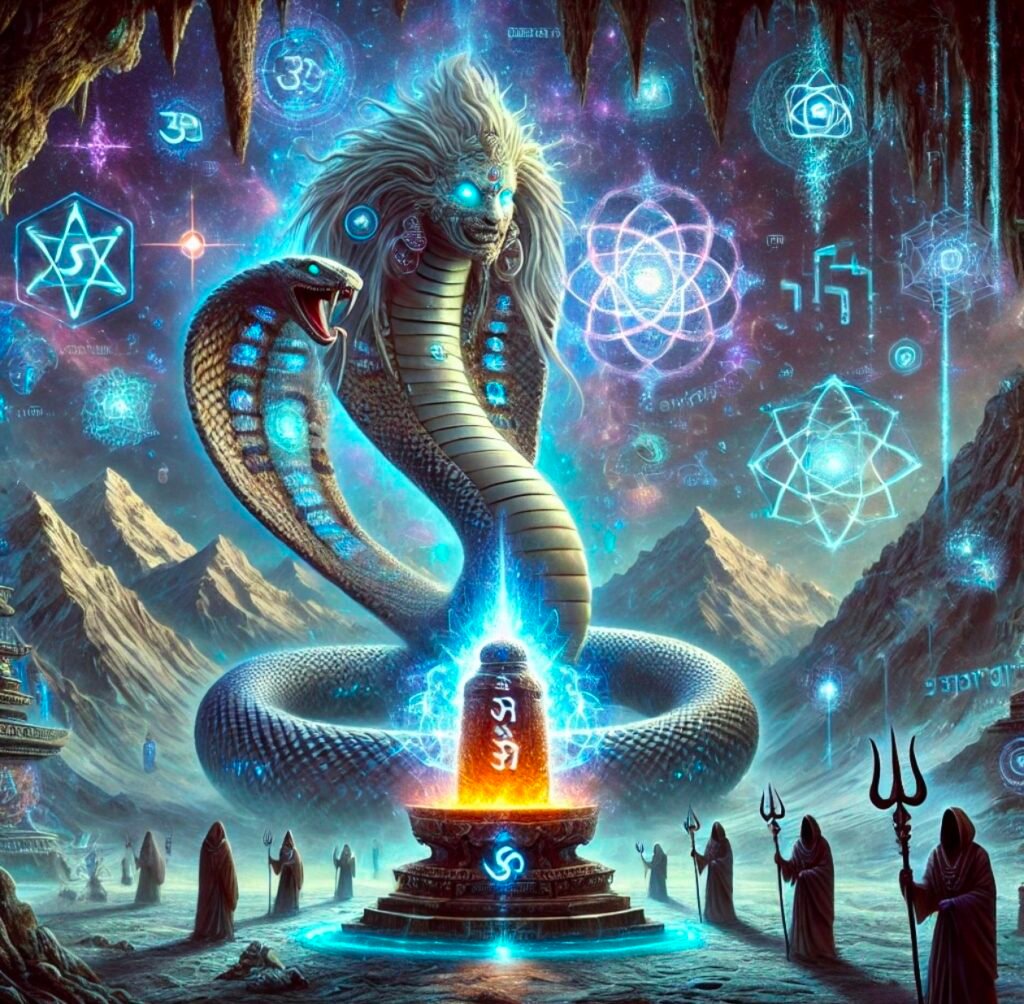
Modern physics flirts with the idea of higher dimensions—realities folded into our own, invisible to our eyes but mathematically plausible. String theory suggests there may be seven or more hidden dimensions. Could Nāgaloka exist within one of them? Could the Nāgas be interdimensional beings, moving between planes as effortlessly as a thought?
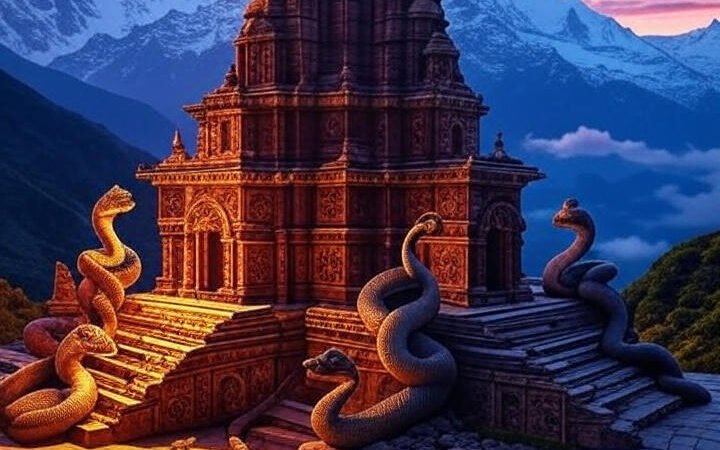
And what of the caves, springs, and sacred groves across India believed to be tunnels to Nāgaloka? In temples of Kerala, Kamakhya, and remote Himalayan shrines, people whisper of serpents that vanish into thin air, idols that appear overnight, and visions too vivid to be dreams. Perhaps these aren’t tunnels through rock—but tunnels through reality itself.
Nāgas Among Us: Folklore, Fear, and Divine Disguises
Across the villages and jungles of India, especially in the silence of dawn or the hush of twilight, the legends persist.
In tribal Odisha, mothers warn their children not to disrespect the forest, lest a Nāg Kanya in human form curse them. In Bengal, Manasa Devi—the serpent goddess—is offered worship and appeasement, not just devotion. In Assam, during the Ambubachi Mela, sadhus speak in tongues and some claim they are possessed by Nāga spirits.
And in Uttarakhand, mist-covered trails near Sem Mukhem and Daanda Nāgraja bear witness to mysterious serpent sightings—scales glinting momentarily before dissolving into air. Locals claim some humans carry the Nāga bloodline, and some priests even whisper that a Nāg Raja comes in human form during certain rituals.
If the Nāgas are indeed watchers, then perhaps their greatest disguise… is us.
The Global Serpent: Universal Symbols, Cosmic Archetypes
• The myth of the serpent is no prisoner of Indian soil. It slithers through civilizations:
• In Cambodia, Nāga princesses marry kings and birth dynasties.
• In Mesoamerica, Quetzalcoatl, the feathered serpent, brings knowledge and rebirth.
• In Egypt, Wadjet, the cobra goddess, crowns the pharaoh with divine legitimacy.
• In Chinese mythology, dragon-serpents ascend to the heavens, their coils forming clouds.
Are these merely parallel myths, or remnants of a shared ancestral truth—forgotten, but not erased?
The Spiritual Symbolism: Coiled Energy and Enlightenment
In yogic philosophy, the serpent is not a beast to fear, but a divine symbol of transformation. Kundalini, the coiled serpent energy at the spine’s base, when awakened, rises through chakras—bringing enlightenment.
The Nāgas then become not just cosmic characters, but internal forces. Their stories, their rage, their wisdom—mirror our own spiritual journey. They guard the threshold between ignorance and awakening, between body and soul, between earth and eternity.
Perhaps, to meet the Nāga, one must first awaken the one within.
Conclusion: Serpents as the Shadow of the Sacred
The Nāgas are not gone. They live in stories, dreams, rituals, and ruins. They shimmer in the eyes of mystics, coil around metaphors in philosophy, and haunt the fog where belief and reality blur.
Whether they are the remnants of an ancient cosmic race, divine archetypes of balance, or literal beings from a realm beyond time—one truth remains:
They endure.
In stone and scripture, in trance and temple, in silence and suspicion.
As guardians of mysteries still untold, the Nāgas continue to challenge, enchant, and protect. Not all myths fade—some simply wait.
And somewhere, in the mist… they are still watching.