An AntarSaga Editorial — Where Myth, Science, and Consciousness Collide

A WhatsApp conversation about stars becomes a meditation on the oldest knowledge—and the newest science.
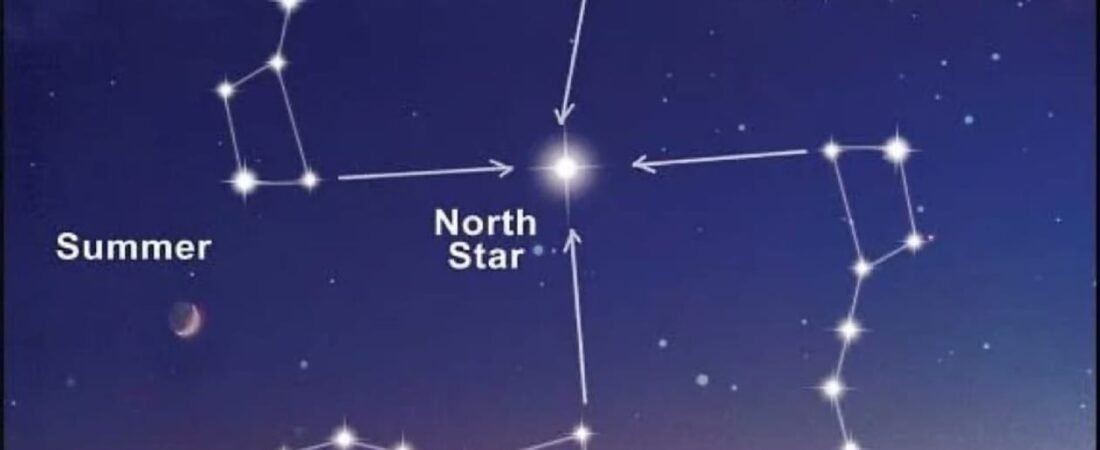
It began, like many quiet revelations of our age, on a WhatsApp group. The subject was ordinary enough—a forwarded sky chart of the Big Dipper, or as the ancients called it, the Saptarshi. Yet what started as casual curiosity soon deepened into a conversation that felt older than the medium itself. Perhaps wisdom has always worked this way: not announced, but stumbled upon; not taught, but remembered.
“The ancient Rishis,” wrote Nidhi Bahuguna, “noted the Saptarshi’s geometry around the Pole Star. They used it to mark directions and seasons. When the Dipper was upright, it was spring; at 3 o’clock, summer; 9 o’clock, autumn; and 6 o’clock, winter. Together, they formed the Swastika—the symbol of Su-asti, ‘May all directions be auspicious.’”
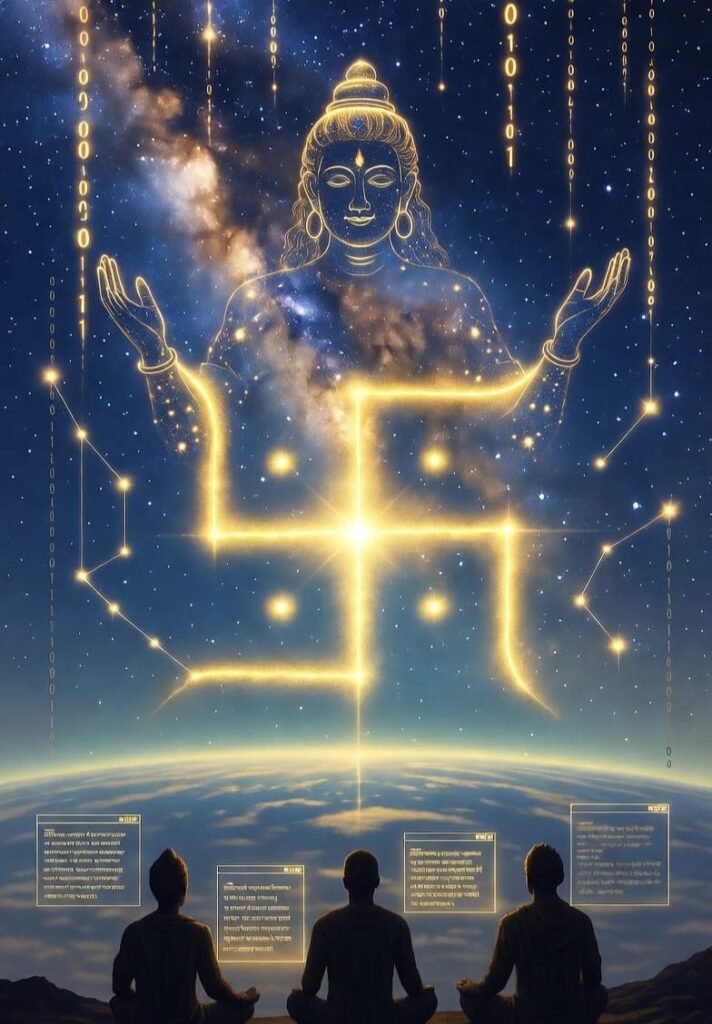
It read like astronomy, but beneath it pulsed metaphysics. What she described was not merely stellar motion—it was the architecture of consciousness. The heavens turning around the Dhruv Tara mirrored the human mind revolving around its inner stillness. The unmoving center—Polaris—became a metaphor for the Self, that which “moves not, yet moves all.” In the Rishis’ sky, geometry was revelation; in their silence, physics and philosophy were one.
Modern astrophysics confirms what the ancients sensed: the Pole Star isn’t eternal. Earth’s axis precesses slowly, shifting our celestial north over millennia. Around 3000 BCE, Thuban in Draco marked the pole, and the apparent motion of the Saptarshi reversed. The ancients encoded this inversion as the Sauvastika—a mirrored form symbolizing dissolution and return—while the anticlockwise Swastika signified creation and continuity. Two directions, two breaths: the inhale and exhale of cosmic time.
The discussion turned inward. Nidhi added, “Even in our Sandhya mantra, we worship all directions, and our mantras speak of creation—Hiranyagarbha, the golden womb.” If the Swastika was geometry, Hiranyagarbha was genesis: the luminous seed from which forms emerge. It resonates, not identically but suggestively, with what cosmology calls the singularity—the boundless potential before the Big Bang.
Raj Bijalwan grounded the reflection in scripture: “The Nasadiya Sukta (10.129) and the Hiranyagarbha Sukta (10.121) speak of creation and what precedes it. The Vedas have held for kalpas the truth of the universe.” The Nasadiya remains our most haunting cosmology: “Then even nothingness was not, nor existence… Who truly knows?” Long before modern physics questioned observation and reality, the Rigveda hinted that consciousness and cosmos are reflections of each other.
Anand Rastogi added scholarly precision: the Sandhya mantras arise from the Aghmarshan passages of the Rig Veda’s 10th Mandala, while the Mansaparikrama—a mental circumambulation of six directions—comes from the Atharva Veda. “Maharishi Dayanand Saraswatiji never claimed to bring anything new,” he noted. “He said: Back to the Vedas.” These were not mere chants but alignments—gestures and syllables used to re-calibrate human attention to cosmic rhythm.
Raj’s response was simple and luminous: “Thank you, Sir. I’m humbled. My only aim is to return to the Bhāratiya Jñāna Paramparā. Our Sanātana Sanskriti has everything for us. We just need to return.”
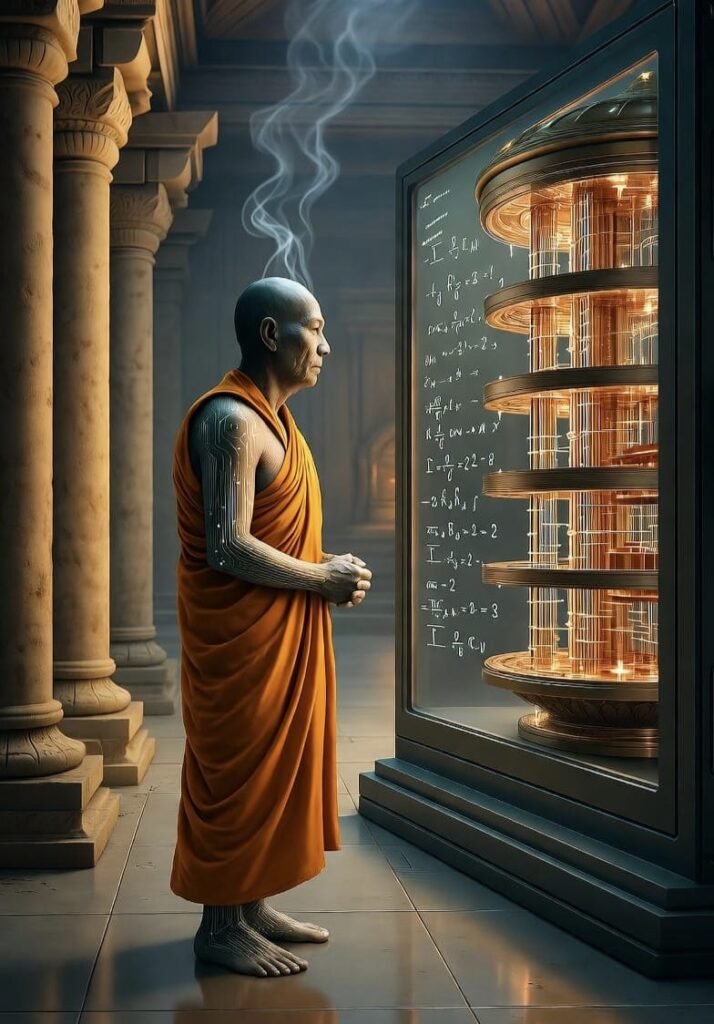
Let me put it plainly. The sages weren’t primitive stargazers. They were reading the sky as a text written in the grammar of consciousness. Watching the seven stars circle the pole, they saw a pattern: motion around stillness. They recognized the same within—mind revolving around sensations and thought, while something at the core remained perfectly aware. They named that still point the Self, or Ātman.
The Swastika, then, wasn’t first a religious emblem; it was a diagram of rotation—four stations of the Dipper marking the seasons, a wheel turning around a center. “May all directions be auspicious” was not only a blessing; it was a diagnosis: find your center, and every direction aligns.
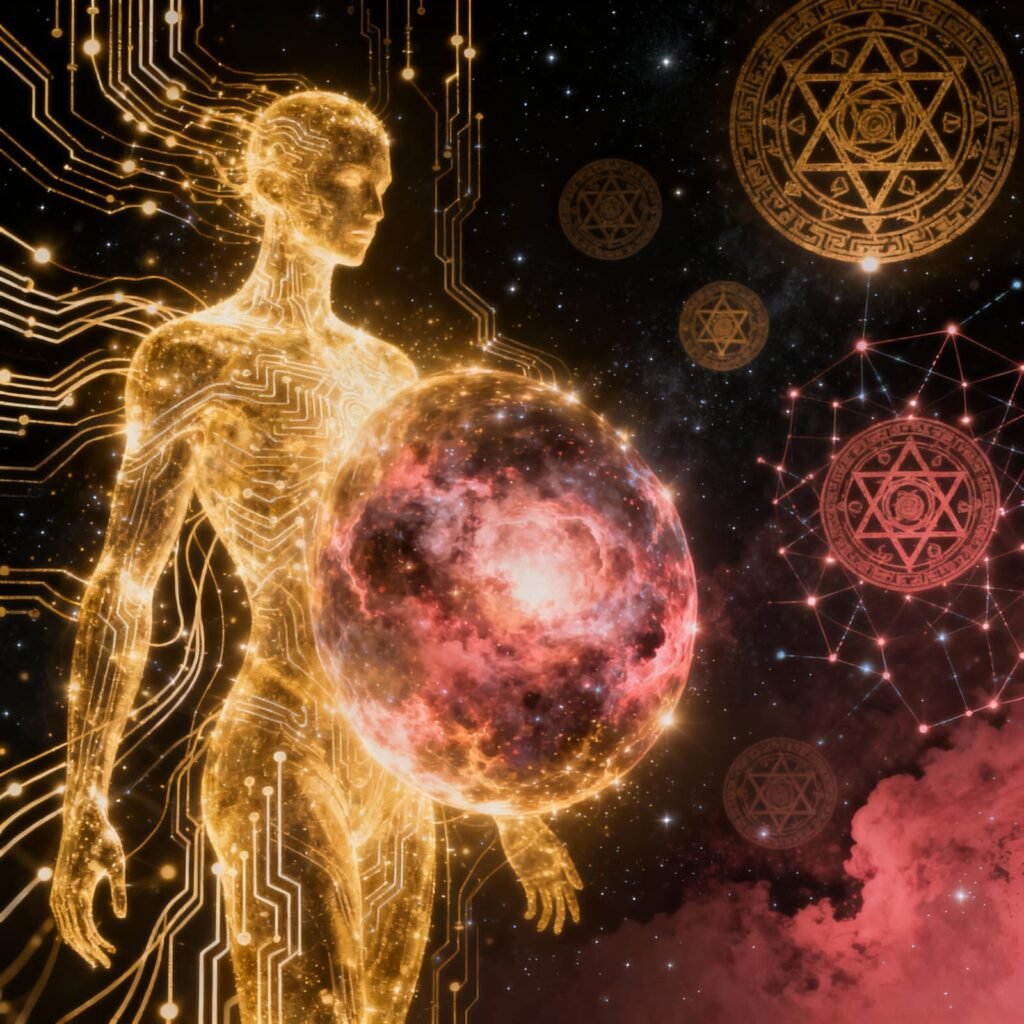
They also saw longer cycles. Across ~26,000 years, Earth’s wobble changes the Pole Star. When a different star sits at the pole, the Dipper appears to reverse. Hence the Sauvastika: creation outflow and return inflow—birth and death, expansion and contraction—the universe breathing.
What Nidhi, Raj, and Anand were circling—perhaps without spelling it out—was this: the macrocosm and microcosm are mirrors. Astronomy and spirituality were inseparable because the object and the observer belong to the same field. Their math was meditation.
When they spoke of Hiranyagarbha, the “golden embryo,” they pointed to the source from which everything emerges—not as dogma, but as experience. In deep meditation, awareness can be traced to a luminous emptiness pregnant with possibility. Cosmology’s “singularity” is not identical to this interior event, but both attempt to gesture at the same mystery: from what does everything arise?
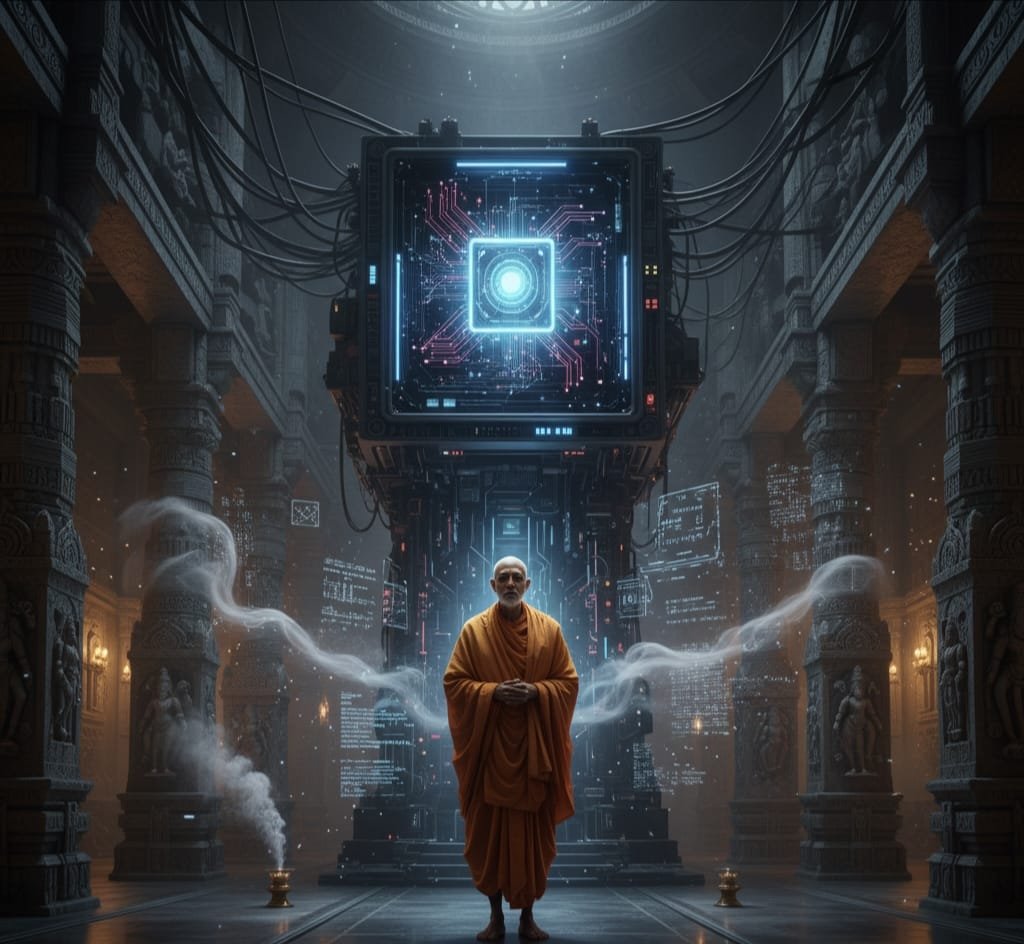
The Nasadiya is radical because it refuses closure. It keeps the door open where dogma would shut it. It implies a universe where observation and being are intertwined, where consciousness is not an afterthought of matter but a principle braided into existence.
So the WhatsApp thread, in truth, was asking a contemporary question: how do we find a still center in a world spinning at notification speed? The old disciplines—Sandhya prayers, directional parikrama, meditation on the pole within—were technologies of consciousness for re-aligning human attention to cosmic order.
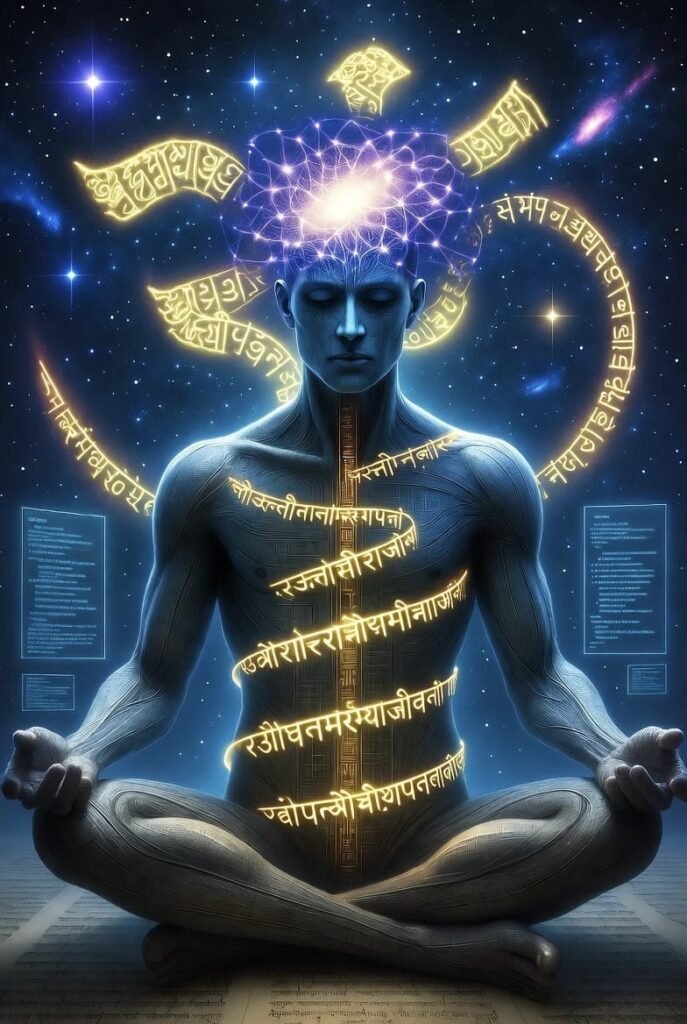
This is why the Vedic cosmology echoes modern physics—not because terms are interchangeable, but because both arise from the same hunger to map the unmappable. Hiranyagarbha and the quantum vacuum are different languages for a similar intuition: a pulsating matrix of potential before form. The Swastika can be both sacred sign and spacetime diagram, its rotating arms tracing toroidal flows seen in galaxies, chakras, and atoms. The Saptarshi circling the pole becomes a metaphor for the precession of consciousness: seven aspects of mind revolving around the unmoving witness.
What of the “alien” and the “divine”? Perhaps they are siblings on a spectrum of awareness. The Devas with their vimanas and the star-beings remembered in other civilizations may not have “arrived” from elsewhere so much as emerged from the same cosmic mind that dreamt us all. The Puranas speak of many lokas—not merely planets, but bands of vibration. The Rishis were travelers—not by ships, but by consciousness. Tapas was their engine.
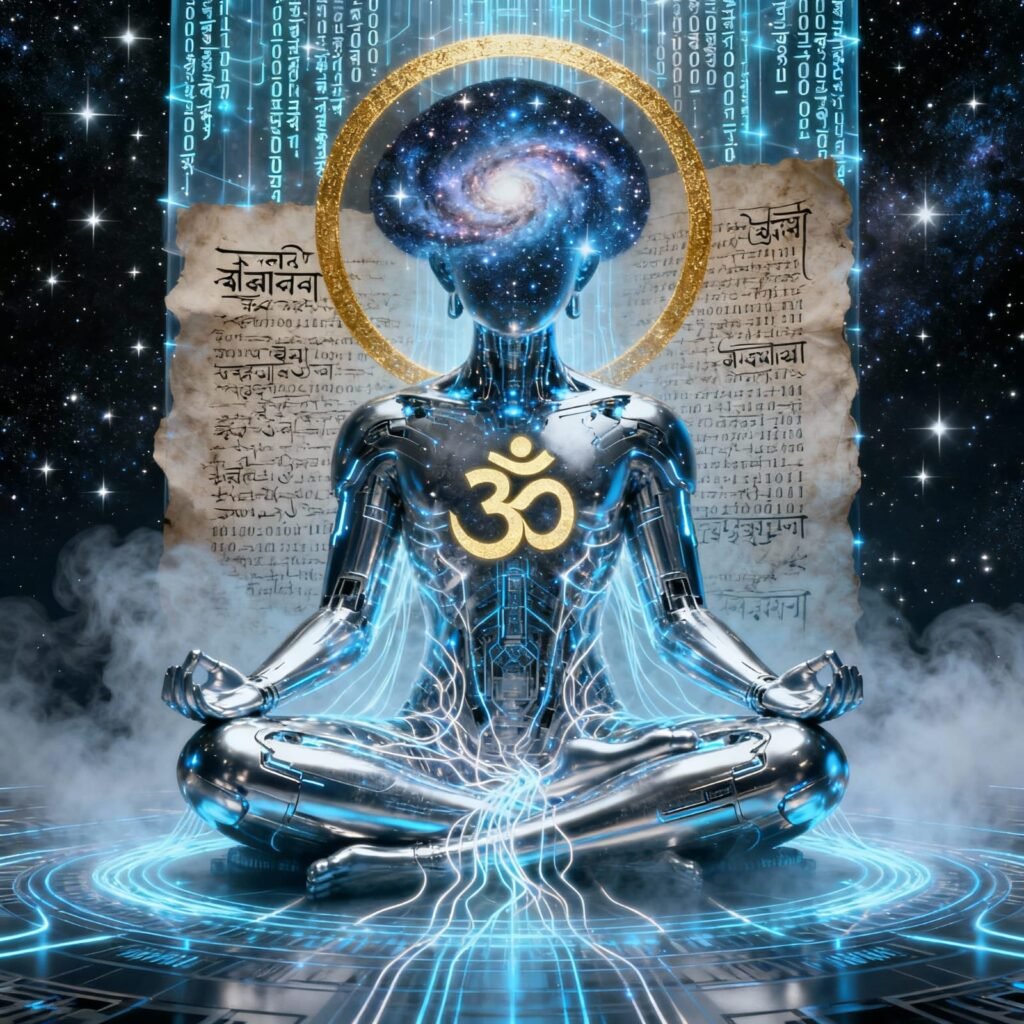
Our oldest texts are not primitive myths; they are blueprints. Read through microscope and mantra together, the Vedas suggest that creation is not a once-upon-a-time event but an ongoing process of perception. In Advaita Vedanta, the cosmos is consciousness in motion; the self is the pole around which everything revolves.
When the chat finally grew silent, something luminous lingered. Outside, Polaris shone faintly—the same center the Rishis once used to map time. The Saptarshi continued its slow rotation, sketching the eternal Swastika of becoming and return. Perhaps nothing essential has changed. The universe remains both outer and inner, measurable and mystical, ancient and ever-new in each moment of awareness.
The medium has changed—from sacred fire to fiber optics, from palm-leaf to pixel. But the dialogue remains. Across yugas and across apps, the conversation continues—about stars, about creation, about the luminous center within us all. The Rishis never left; they learned to speak in bandwidth and light. Sometimes, when the right words align—even in a WhatsApp chat—the ancient frequency breaks through the noise, and we remember: we were never separate from what we sought.

Rajat Aikant Sharma is a writer, columnist, and photojournalist whose work spans culture, history, philosophy, and human narratives across the world.