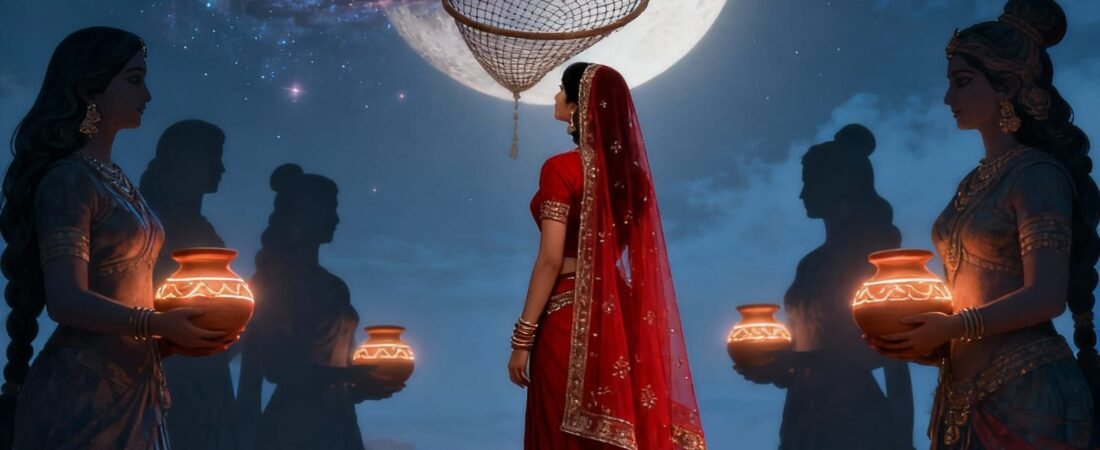
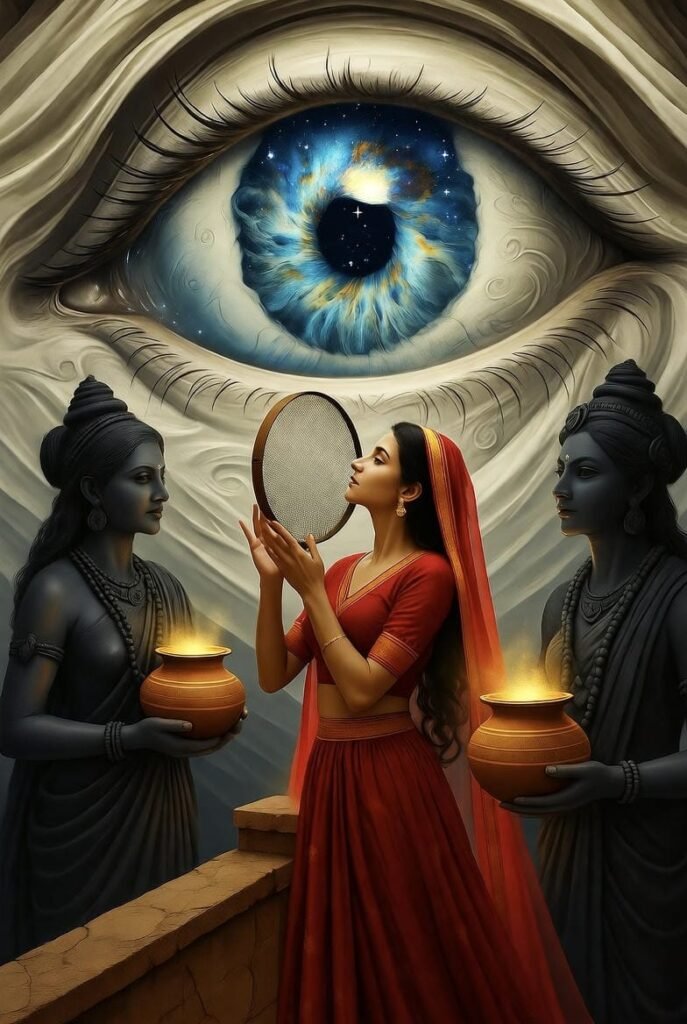
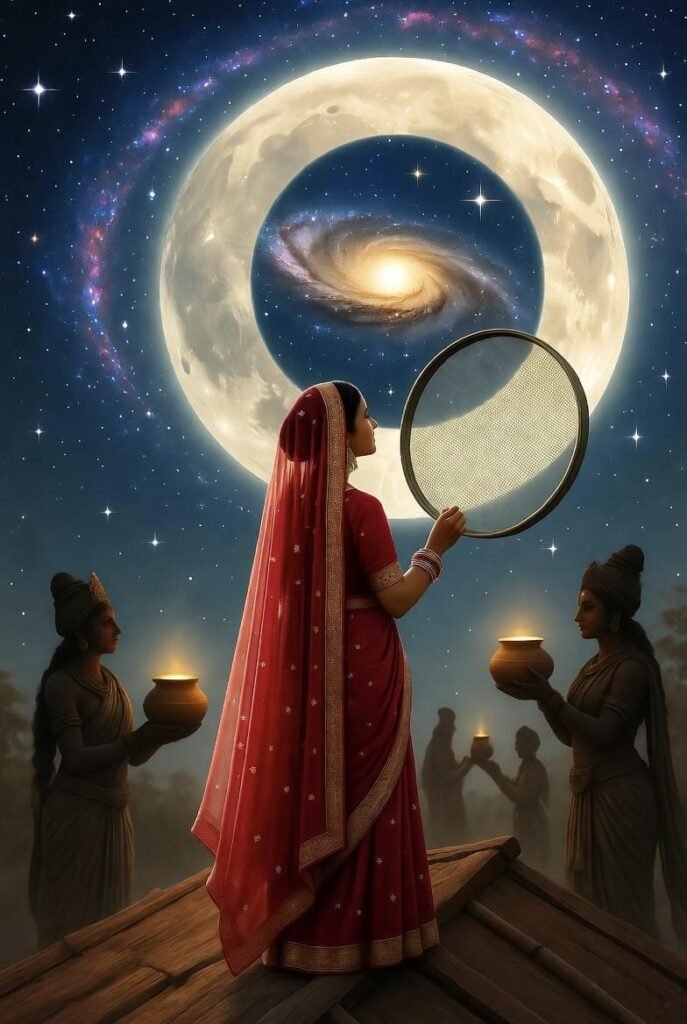
Tonight, as the moon ascends in quiet splendor, millions of women across India will lift their eyes skyward, sieves in hand, fasting hearts filled with devotion. Karva Chauth—a ritual often reduced in urban imagination to mehendi designs, bridal saris, and Instagram reels—is in truth a cosmic dialogue, a yearly meditation on love’s defiance of mortality.
It is a night when time itself seems to pause: the pot (karva) filled with water, the sieve framing the moon, the patient fast breaking only when the beloved’s face appears. But beneath the delicate choreography of rituals lies a story that predates modern culture by millennia, echoing through the vast forest of the Mahabharata. A story that insists love is stronger than death, devotion sharper than destiny.
Into the Forest: The Tale of Savitri
When the Pandavas wandered in exile, weary and disheartened, Yudhishthira once asked sage Markandeya for solace. The sage responded not with lectures or advice, but with a story—a story he knew would shine like a lamp against despair.
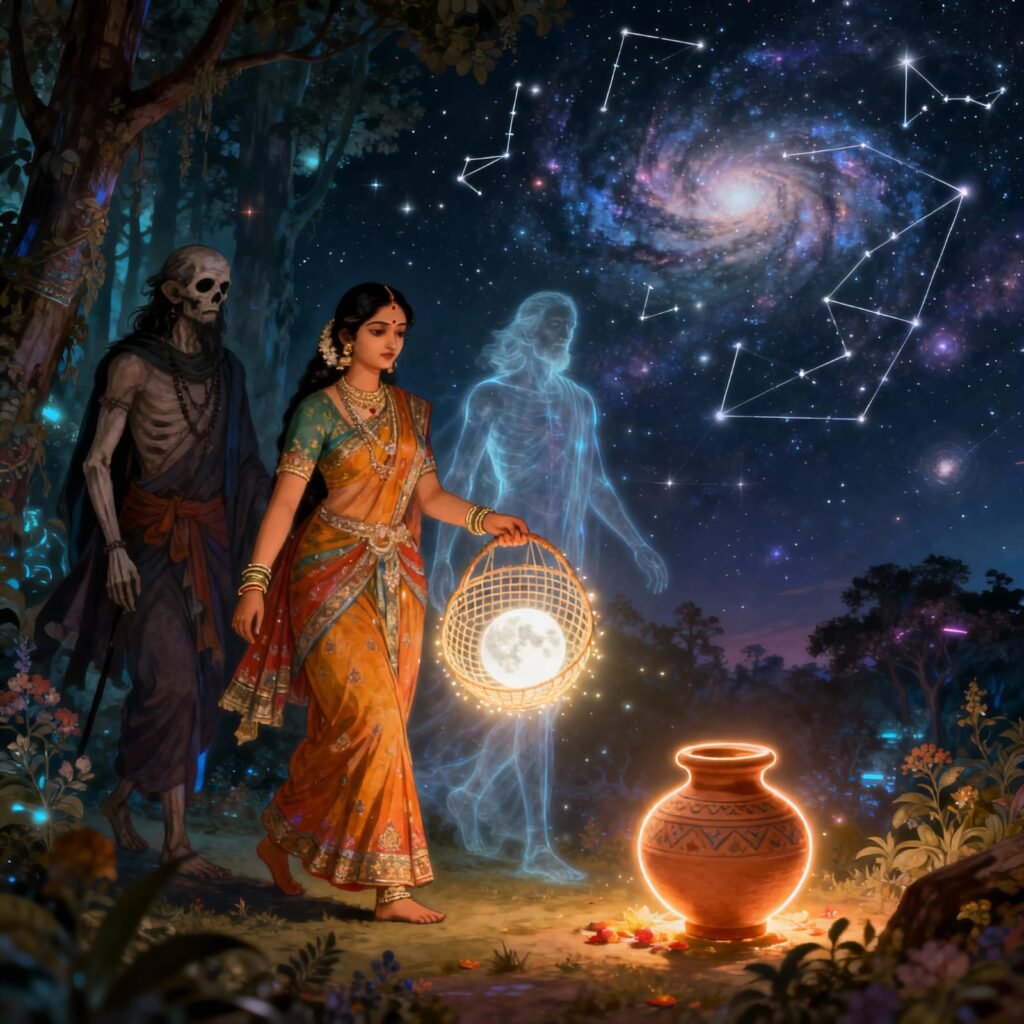
He spoke of Savitri, the princess who chose Satyavan, a noble but doomed prince. She was warned by astrologers that he was destined to die within a year of marriage. Did she hesitate? No. In a decision that today would scandalize any matchmaking app, Savitri married Satyavan anyway, choosing love over certainty.
Life with Satyavan in the forest was tender yet shadowed by fate. On the foretold day, Satyavan collapsed, his breath stolen by inevitability. It was then that Savitri’s courage revealed its true form.
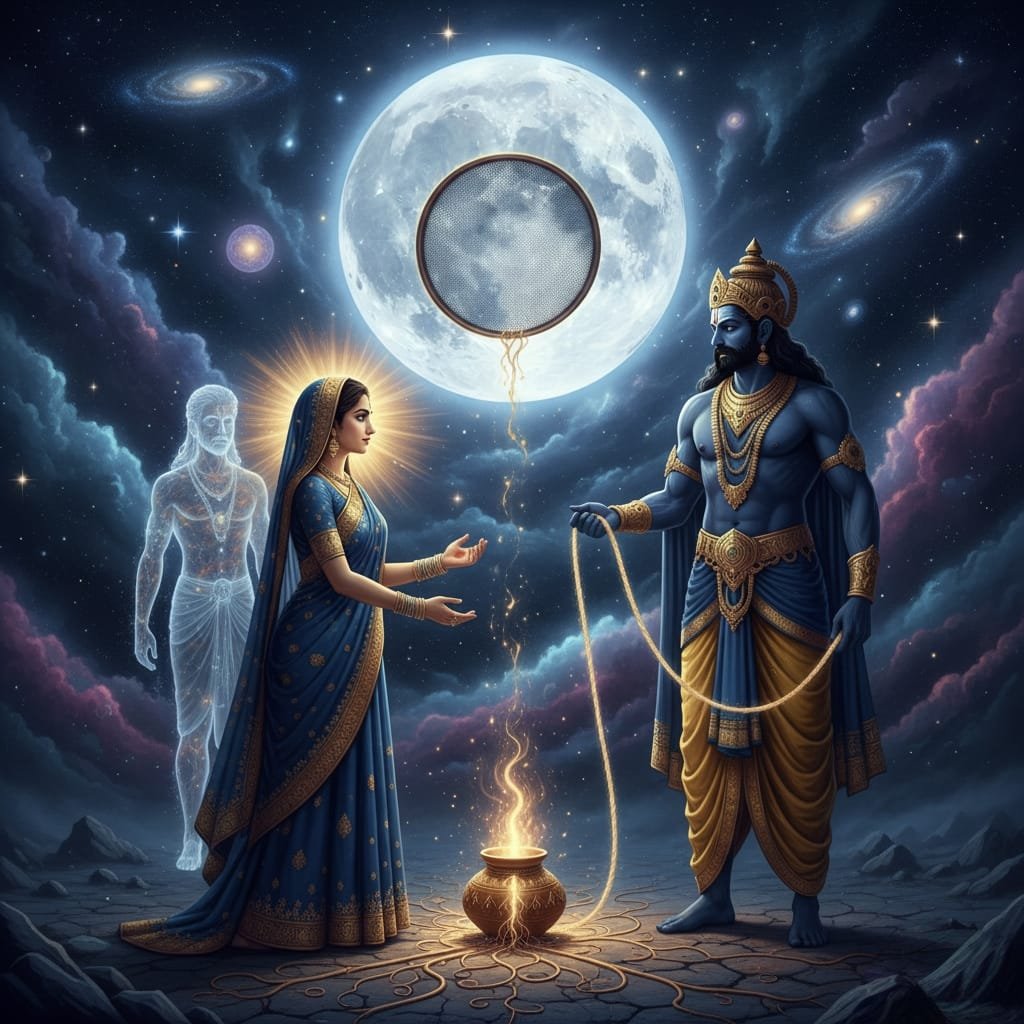
As Yama, the god of death, appeared to claim Satyavan’s soul, Savitri followed him—undaunted, relentless. This was not the dutiful silence expected of women in ancient texts. This was eloquence sharpened into a weapon. She engaged Yama in dialogue, her words more precise than arrows, her devotion steadier than mountains.
“Return my husband,” she demanded, cloaked not in desperation but in reasoning. With each boon Yama reluctantly granted—sight, kingdom, children—she asked for more, until logic itself forced him into a corner. For how could she have children without her husband alive? Death, checkmated, yielded.
And so Satyavan returned to life—not as a miracle, but as testimony. Testimony to love’s power, intellect’s resilience, devotion’s audacity.
If Yama expected an easy walk that day, he had clearly never bargained with an Indian bride.
The Philosophy Beneath the Story
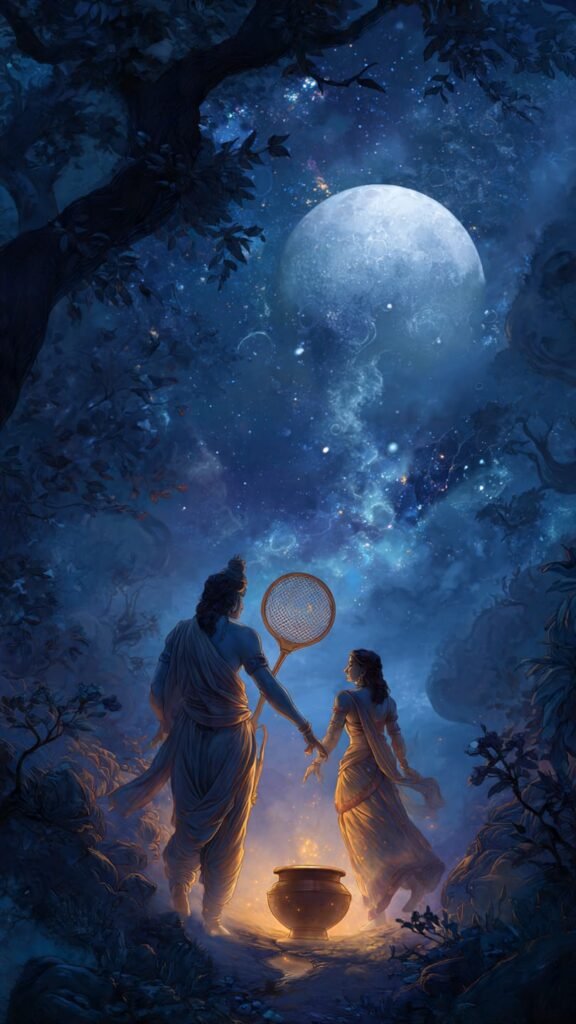
Savitri’s triumph is no fairy-tale twist. It is a philosophical parable, mirroring the heart of Advaita Vedanta: that the individual self (Atman) is not separate from the universal (Brahman). Death is not annihilation, but transformation; love is not mere emotion, but the thread connecting finite existence with infinite consciousness.
Every ritual of Karva Chauth reflects this philosophy. The fasting disciplines the senses. The karva—a humble clay pot—reminds us of our bond with earth. The sieve is symbolic too: we never look at the moon directly, but through a filter, just as love softens the harshness of fate. And the moon itself—eternal witness of lovers across centuries—becomes the silent stage for this cosmic theatre.
Science, Stars, and the Mahabharata’s Sky
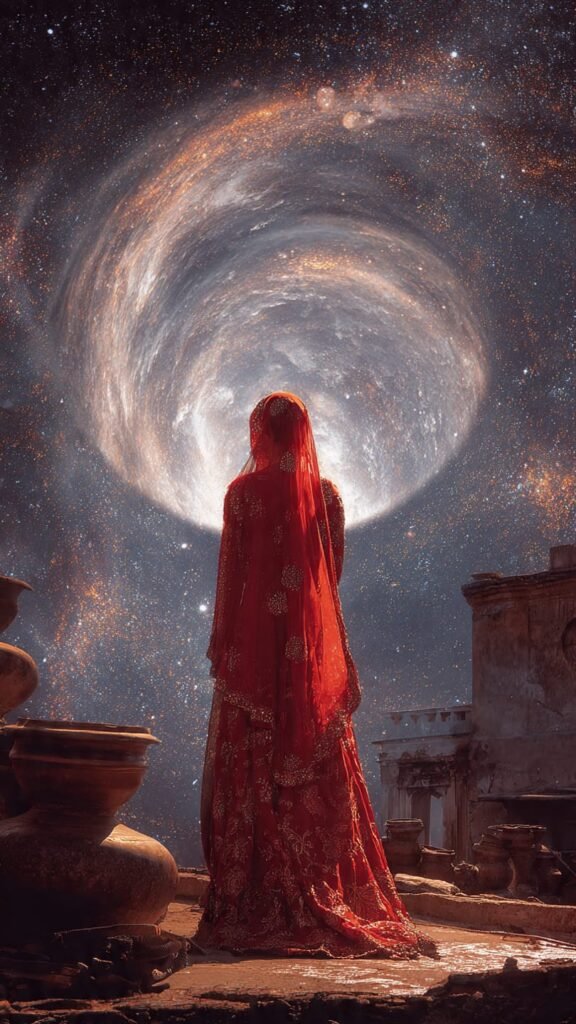
Skeptics may scoff at such tales, dismissing them as myth. Yet, the Mahabharata is not just a text of fantasy. Astronomical references embedded in its verses have been decoded by scholars, placing its events thousands of years before recorded history. Some suggest around 5561 BCE for the war’s timeline.
This does not reduce Savitri’s story to mere history—it elevates it. It tells us that our ancestors were not only storytellers but also observers of the cosmos. They understood that human love was inseparable from cosmic rhythms, that devotion was not a private act but part of a universal order.
Tonight’s moonrise is thus not just a pretty sight; it is an ancient calendar, an astronomical whisper reminding us that our small rituals are echoes of greater cycles.
Between Desert and Drawing Room: Karva Chauth Through Time
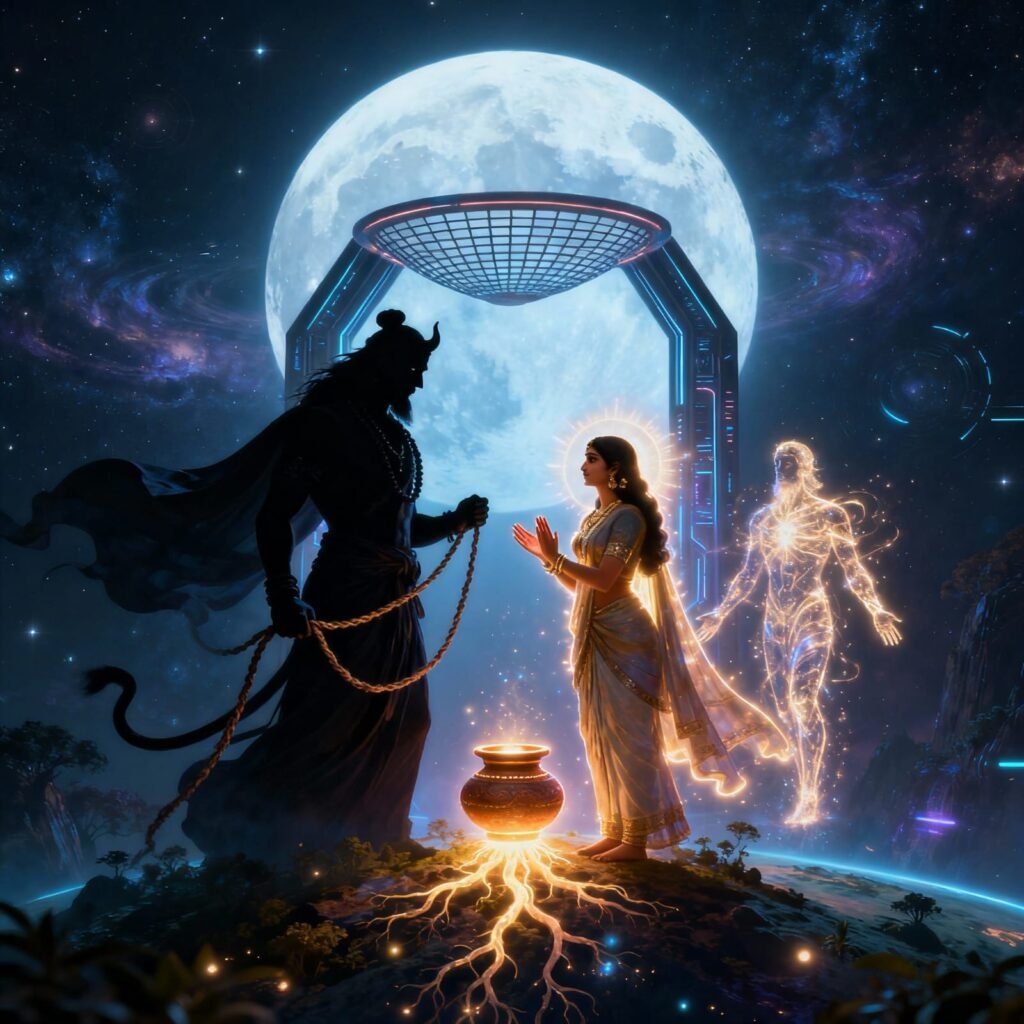
Karva Chauth itself is a fascinating cultural bridge. In Rajasthan, it was once observed by women praying for husbands who left on dangerous desert journeys. In Punjab, it became entwined with agricultural cycles. In today’s cities, it often arrives with sargi breakfast platters sent lovingly by mothers-in-law and ends with selfie sessions beneath high-rise balconies.
But the heart remains unchanged. Whether in a thatched hut or a modern apartment, women unite in this act of faith. They laugh together during the puja, tease each other, share folk songs, and then gaze at the moon with the same longing Savitri must have felt in that dark forest.
The wit of tradition is not lost here. In earlier times, women fasted to protect husbands from wars. Today, some joke that they fast so their husbands return safely from Gurgaon traffic. Times change; devotion does not.
Savitri, Yama, and the Modern Cosmos
What does Savitri’s tale mean in an age of artificial intelligence and space telescopes? Perhaps it means more than ever.
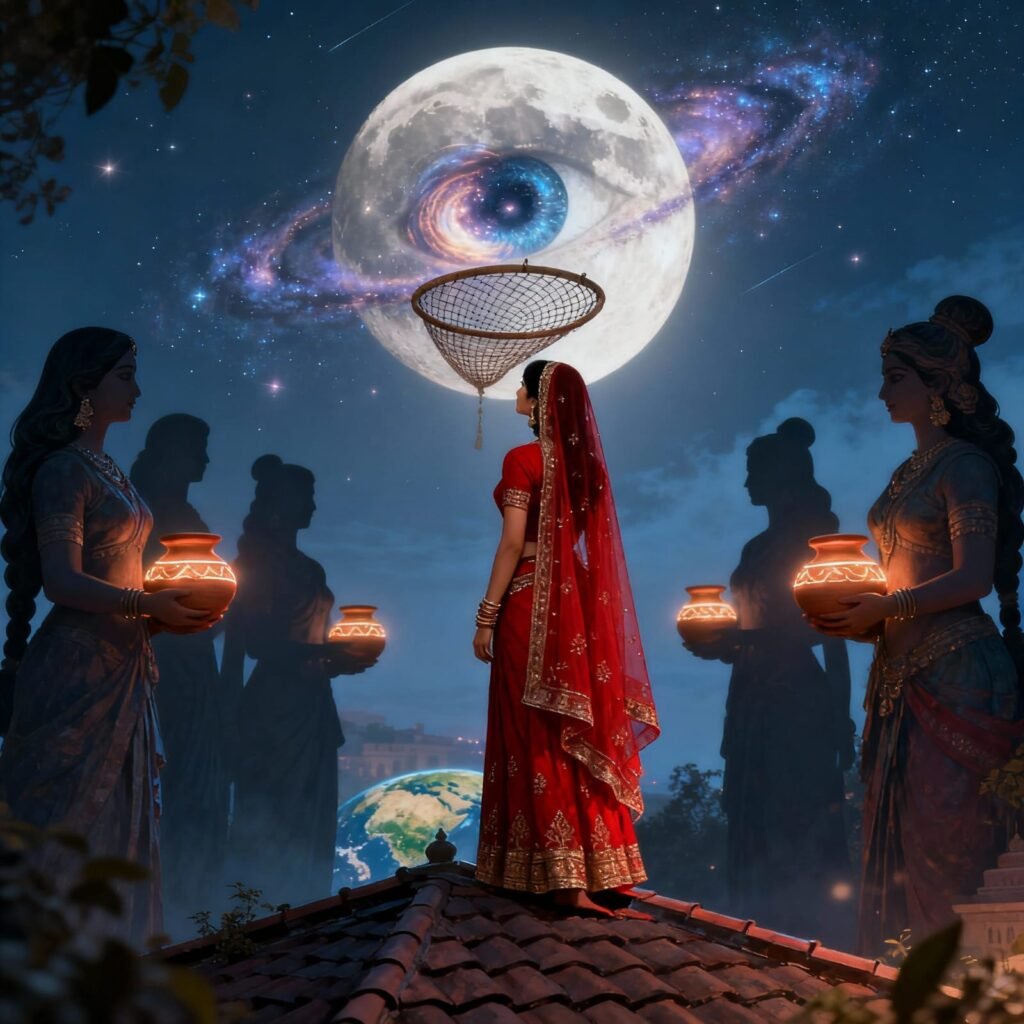
Think of her walk with Yama as a journey across dimensions. She was not merely following death into darkness; she was crossing thresholds into unseen realities. Today, physicists speculate about wormholes, parallel universes, and the nature of consciousness itself. Savitri’s story anticipates this timeless human quest: to pierce beyond the veil, to negotiate with the unknown.
And as AI reshapes the world, her story offers something no machine can replicate—the moral courage of devotion, the wit of resilience, the logic sharpened by love. Algorithms may calculate probabilities, but they cannot confront Yama with unwavering resolve. Only Savitri could do that.
A Living Legacy
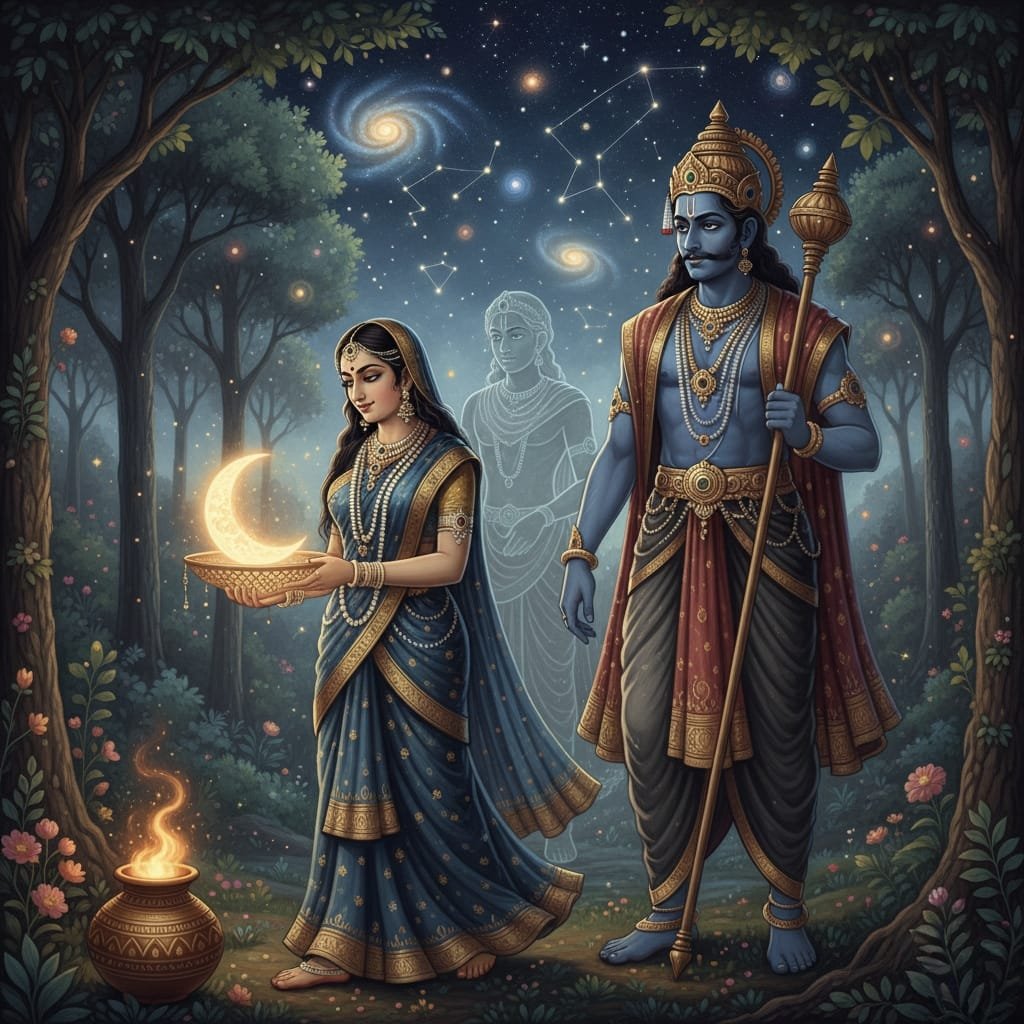
Tonight, when countless women lift their sieves to frame the moon, they will unknowingly reenact Savitri’s defiance. They will participate in a dialogue across millennia: between mortal hearts and cosmic forces, between ancient sages and modern seekers.
Karva Chauth is not about hunger or submission. It is about remembering that love is a power strong enough to bend destiny, that devotion can transform despair, that even death yields when faced with truth.
And so, under the silver gaze of the moon, Savitri still walks with us. She whispers that time is an illusion, that love is the real immortal, that each fast and each prayer is less about prolonging a husband’s years and more about affirming the eternal within ourselves.
Conclusion: From Forest to Cosmos
From the shadowed groves of the Mahabharata to tomorrow’s neon-lit cities, the story of Savitri remains unchanged: a woman’s devotion conquering the unconquerable.
As we look at the moon tonight, let us remember that we are not just watching a ritual—we are touching a legend, reliving a philosophical truth, and stepping into a cosmic rhythm older than history.
For Savitri did not simply win back her husband. She revealed that love is stronger than time, courage deeper than death, and devotion luminous enough to guide even gods.
That is the legacy of Karva Chauth: an unbroken dialogue between earth and cosmos, past and future, mortal and divine.
Rajat Aikant Sharma is a writer and photojournalist exploring culture, history, and human stories. Beyond print, he creates digital content, posters, and social campaigns that extend his editorial voice into the world of influencer engagement and brand storytelling.