Dehradun | 18 July 2026 | AntarSaga News Desk
In a significant development, Uttarakhand Chief Minister Pushkar Singh Dhami has announced that tree felling for the proposed Dehradun–Rishikesh four/six-lane highway project will remain suspended until wider consultations are held with all stakeholders. The announcement follows days of peaceful protests, environmental appeals and public discussions over the ecological impact of the project.
In his statement, the Chief Minister reaffirmed that the highway remains an important infrastructure project of the National Highways Authority of India (NHAI), being implemented in accordance with judicial directions and statutory approvals. He also highlighted provisions such as a 3.5-kilometre elephant underpass and dedicated wildlife crossings aimed at reducing human-wildlife conflict.
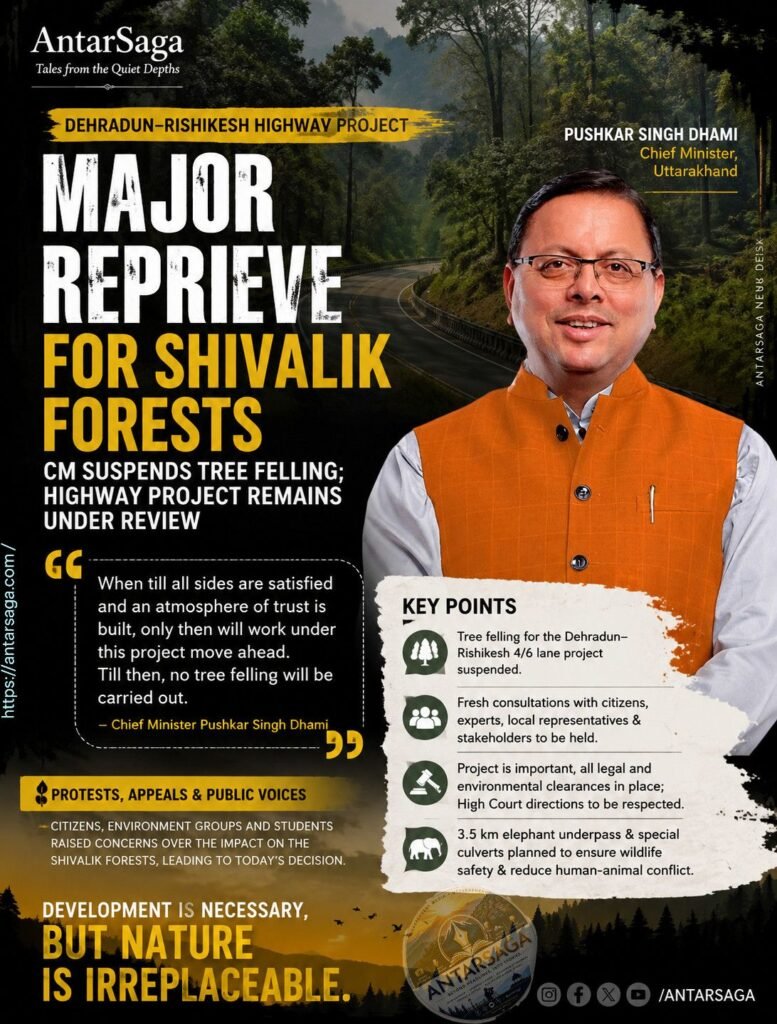
However, acknowledging the concerns expressed by citizens, environmentalists and local communities, the state government has directed officials to initiate fresh dialogue with stakeholders. Until an atmosphere of confidence and consensus is established, tree felling for the project will remain on hold.
The announcement comes after several days of demonstrations in Dehradun and Rishikesh, where residents, students, environmental groups and social organisations urged the government to reconsider the scale of tree loss and explore alternatives. Peaceful gatherings, symbolic tree-hugging campaigns and public appeals brought the issue into the centre of Uttarakhand’s public discourse.
The project itself has not been cancelled. Instead, the government’s latest decision signals a pause in one of its most debated aspects while discussions continue on balancing infrastructure development with environmental conservation.
For a Himalayan state like Uttarakhand, this conversation extends beyond a single road. It raises enduring questions about how development should move through landscapes that are ecologically fragile and culturally significant. Roads connect people, forests sustain life, and governance often lies in finding a path that respects both.
For now, the machines are silent, the forests still stand, and the dialogue continues. Whether this pause becomes a turning point or simply an interval before the next decision will depend on the conversations that follow.
At its heart, this moment is not only about a highway or a forest—it is about the evolving relationship between development, democracy and public participation in Uttarakhand.