
Why Mussoorie’s ABVP Joined a Nationwide Cry for Fair Examinations
From the mist-covered hills of Mussoorie to the protest lines of Jantar Mantar, one question echoed across campuses on Thursday: if merit is the foundation of India’s future, who will protect merit itself?

On Thursday morning, the campus of Municipal Post Graduate (M.P.G.) College, Mussoorie, became part of a nationwide movement as the Akhil Bharatiya Vidyarthi Parishad (ABVP) organised a demonstration against alleged examination irregularities, the NEET controversy and growing concerns over the credibility of India’s competitive examination system.
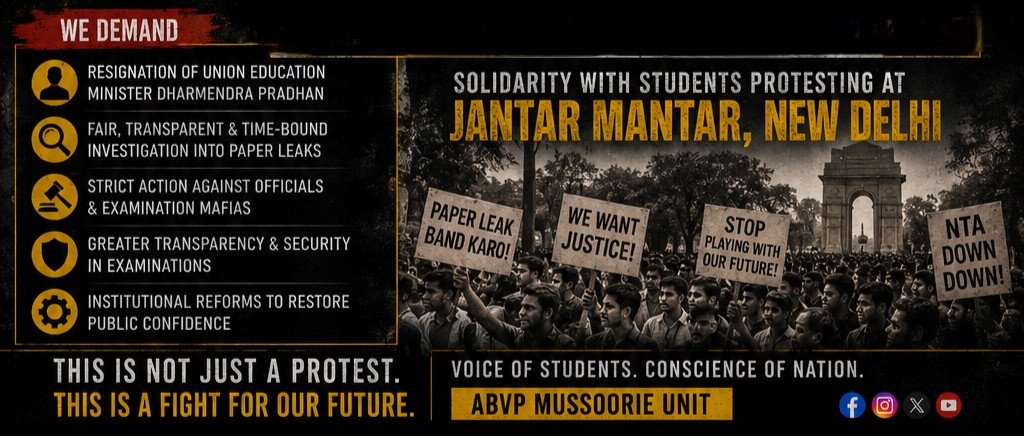
The protest was one among several organised by ABVP units across the country on the day, demanding accountability, transparency and structural reforms in the wake of repeated examination controversies. Nationally, the organisation called for impartial investigations, strict punishment for those responsible and restoration of students’ faith in public examinations.
Mussoorie, however, added its own voice.
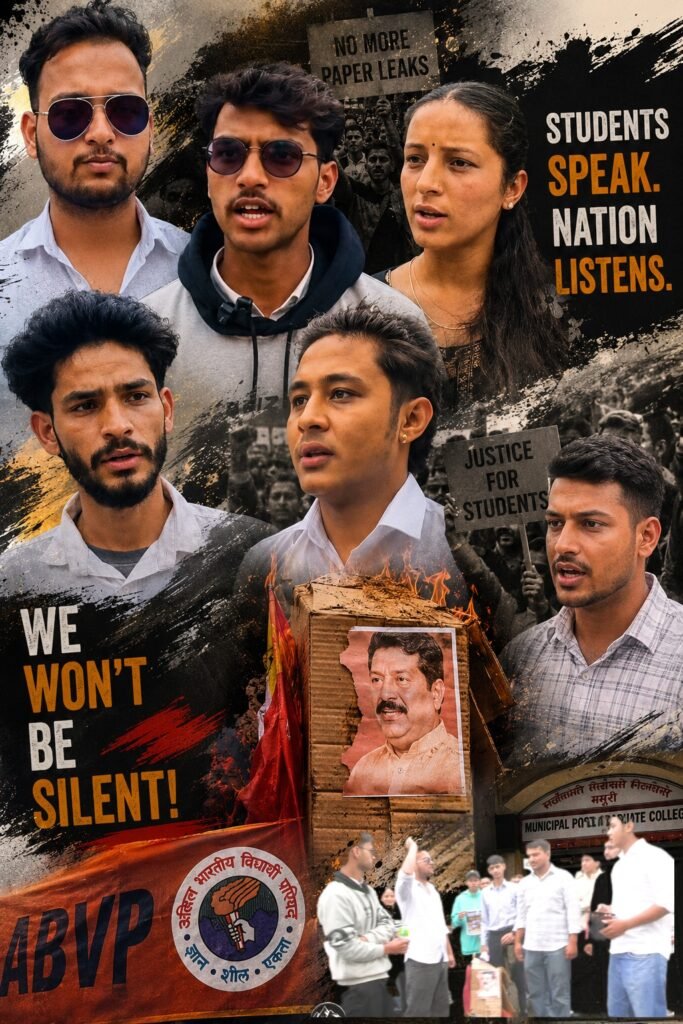
Students burnt an effigy of Union Education Minister Dharmendra Pradhan, demanded his resignation, condemned the alleged police action against protesting students at Jantar Mantar, questioned the functioning of the National Testing Agency (NTA) and repeatedly insisted that their movement was not about political parties—but about students.
When A Student Organisation Questions The System
Perhaps the most striking aspect of Thursday’s demonstration was not the slogans.
It was who was raising them.
ABVP is widely regarded as India’s largest student organisation and is often perceived as ideologically aligned with the RSS. Yet, speaker after speaker asserted that when students suffer, no government should be beyond criticism.
Leading the demonstration were Ashutosh Joshi (University Representative), Anuj Panwar (Students’ Union Vice President), Vansh Thapli (ABVP Unit President), Karishma (Joint Secretary), Naman Malla (Treasurer), Vikas Rawat, along with ABVP workers and students.
Almost every speech carried the same central message:
“Today we are here as students first.”
Beyond NEET: A Crisis Of Trust
Nationally, ABVP’s demands have centred around transparent investigations, strict action against paper leak networks, reforms in the examination system and restoring confidence among students.
In Mussoorie, however, students also linked the issue with the recent Patwari and Lekhpal recruitment controversies in Uttarakhand, arguing that repeated examination irregularities have left young aspirants increasingly uncertain about whether merit alone can secure their future.
For them, this was not merely a protest against one examination.
It was a protest against the slow erosion of trust.
“Are Students Being Treated Like Terrorists?”
Among the strongest speeches came from Ashutosh Joshi, University Representative of M.P.G. College.
Ashutosh Joshi
University Representative
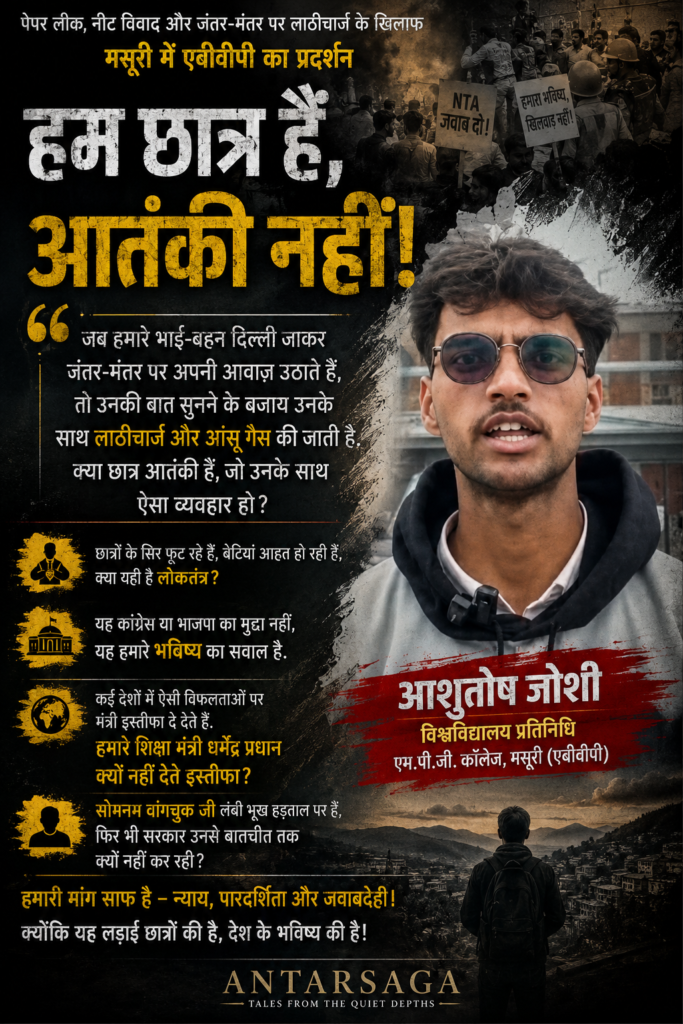
“When our brothers and sisters travel to Delhi to raise their voices, instead of being heard they are met with lathi-charge and tear gas. Are students terrorists? This is not about Congress or BJP. This is about our future. In many countries ministers resign after such failures. Why has Union Education Minister Dharmendra Pradhan not resigned? Why has there still been no meaningful dialogue with Sonam Wangchuk?”
Joshi also alleged that several protesting students were injured and that women protesters were mistreated during the police action, saying democratic dissent should be answered through dialogue rather than force.
One Examination. One Lost Year. One Family’s Dream.
For Anuj Panwar, the protest was less about politics than about sacrifice.
Anuj Panwar
Students’ Union Vice President
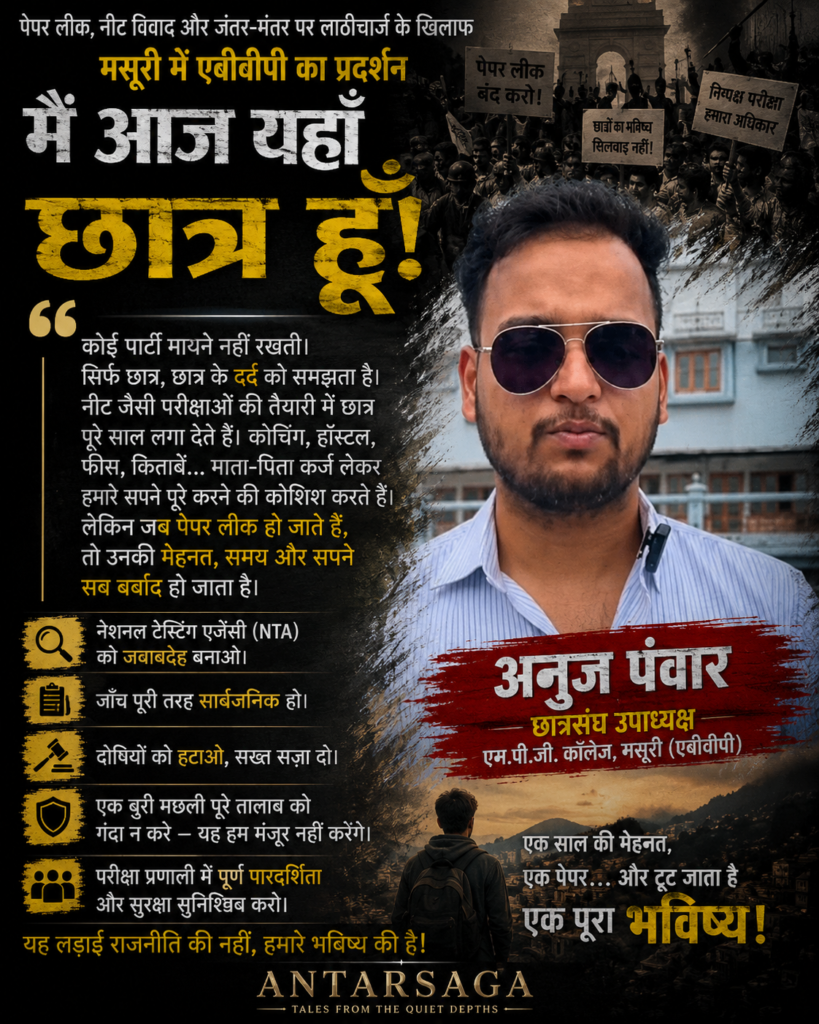
“Today I am here as a student. Party lines do not matter. Students prepare for examinations like NEET for an entire year. Many leave home, join coaching institutes and their parents take loans to support them. When papers leak, all that hard work is destroyed. Why should students pay for failures in the system? The National Testing Agency must be held accountable and the inquiry should be made public.”
Panwar also questioned why students repeatedly bear the burden of administrative failures while institutions escape accountability.
“Student Welfare Comes Before Politics”
Vansh Thapli, ABVP Unit President, rejected the idea that the demonstration was politically motivated.
Vansh Thapli
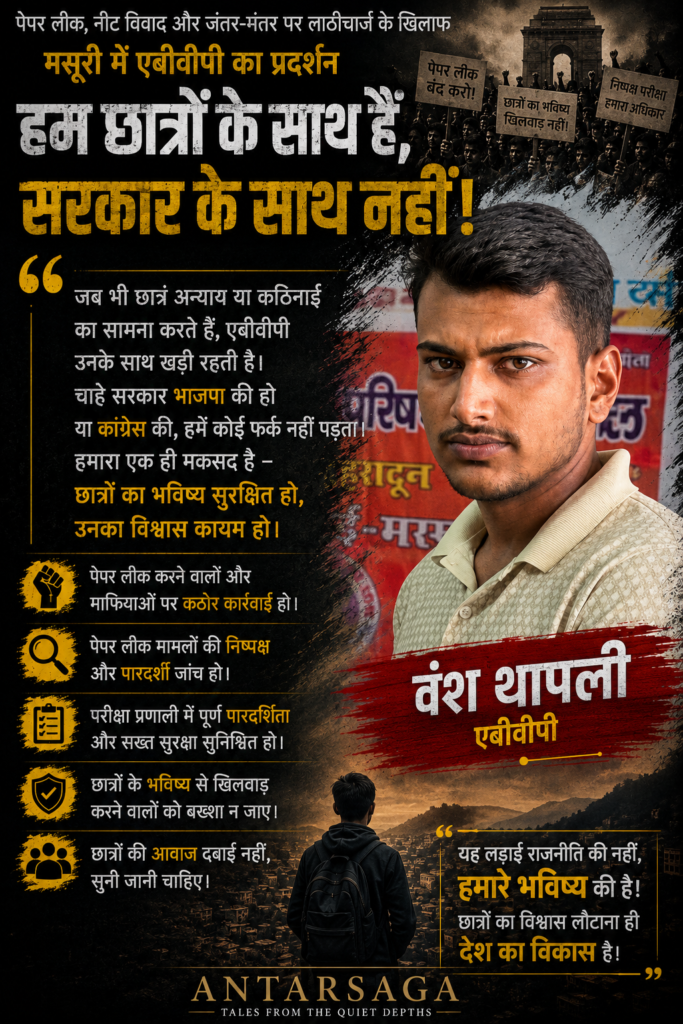
“Whenever students face injustice, ABVP will stand with them. It does not matter whether the government is led by the BJP or the Congress. Our concern is students and their future.”
Different Voices, One Demand
Each speaker approached the issue from a different perspective, but all returned to the same concern.
Vikas Rawat responded to those questioning why ABVP had joined the protests despite its perceived proximity to the ruling establishment.

“People ask why ABVP is protesting. Our answer is simple—whenever students suffer, we will not spare any government. We demand the resignation of Dharmendra Pradhan, compensation for families of students who, according to us, lost their lives due to examination-related distress, and a transparent education system.”
Karishma, Joint Secretary, spoke about the emotional burden carried by families.
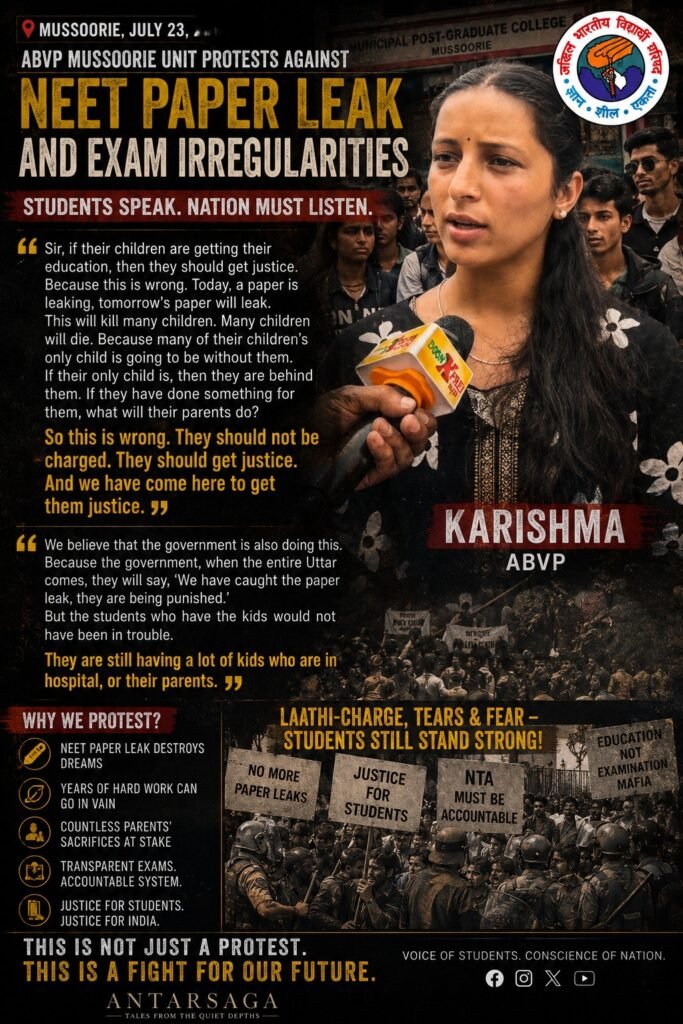
“Students deserve justice. Every paper leak destroys years of hard work and the dreams of parents who have sacrificed everything. Merely saying that those responsible have been caught is not enough if students continue to suffer.”
Naman Malla, Treasurer, reminded the gathering that the protest should not be viewed through a political lens.
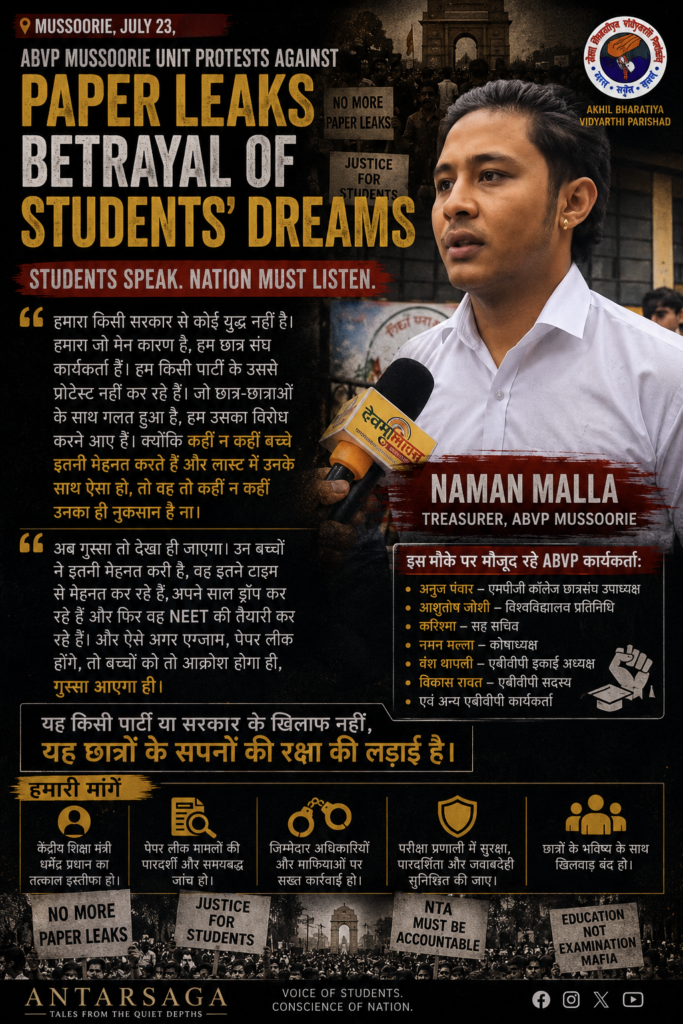
“We are not fighting any political party. We are standing against injustice. Students spend years preparing, often dropping an academic year for examinations like NEET. Their anger is natural when their hard work is undone.”
Why The NTA Became The Focus
Throughout the protest, speakers repeatedly questioned the functioning of the National Testing Agency, the body responsible for conducting examinations including NEET, JEE Main and CUET.
The demand was not merely for punishment of individuals.
Students repeatedly argued that systems must become stronger than scandals.
They called for transparent investigations, institutional accountability, stronger safeguards against paper leaks and reforms that restore confidence in competitive examinations.

The Price Parents Quietly Pay
Perhaps the most overlooked casualty of examination controversies is not the institution.
It is the family.
Behind every successful aspirant stands a parent who has quietly taken loans, paid coaching fees, postponed personal dreams and trusted that merit would eventually prevail.
When examinations themselves become suspect, it is not merely question papers that leak.
Years of sacrifice begin leaking away with them.
A Nation’s Toughest Examination
Every competitive examination is an unwritten promise.
The student promises effort.
The nation promises fairness.
When that promise weakens, rankings lose meaning and merit begins to feel uncertain.
Whether one agrees with every slogan raised in Mussoorie or not, Thursday’s demonstration reflected a concern now visible across campuses in India.
Young people are asking for something far deeper than another examination.
They are asking whether honesty, perseverance and hard work still matter.
Long after the slogans fade from the hills of Mussoorie, another examination will remain.
Not of students.
But of institutions.
Not of memory.
But of credibility.
Because the greatest question before India today is no longer whether its students are prepared for the future.
It is whether the future being prepared for them is worthy of their faith.
